
The phone starts ringing before the first patient arrives. A receptionist is checking in a child, confirming a pathology result has reached the doctor, and trying to settle an appointment dispute when another call rolls to voicemail. By lunchtime, the team is returning calls from patients who needed a booking, a cancellation, a reschedule, or a clear answer about what happens next.
That pressure makes virtual receptionist services attractive to Australian clinics. But answering more calls isn't the same as delivering safe, useful reception. The service must book into the correct diary, recognise requests that need a person, protect health information, and leave staff with an accurate record of what happened.
Table of Contents
- The Critical Role of Reliable Clinic Reception
- Comparing Live Operators, AI Voicebots, and Hybrid Models
- Appointment Booking and Practice Management Integration
- Navigating Privacy, Consent, and Data Security
- Clinical Risk Management and Escalation Protocols
- Cost Analysis and Implementation Considerations
The Critical Role of Reliable Clinic Reception
A busy front desk rarely fails because staff don't care. It fails because one person is expected to manage several channels at once. The phone rings while patients queue at reception, clinicians ask for help locating documents, and administrative work accumulates in the gaps between consultations. A missed call may be a routine reschedule, but it may also be a new patient trying to secure an appointment before giving up.
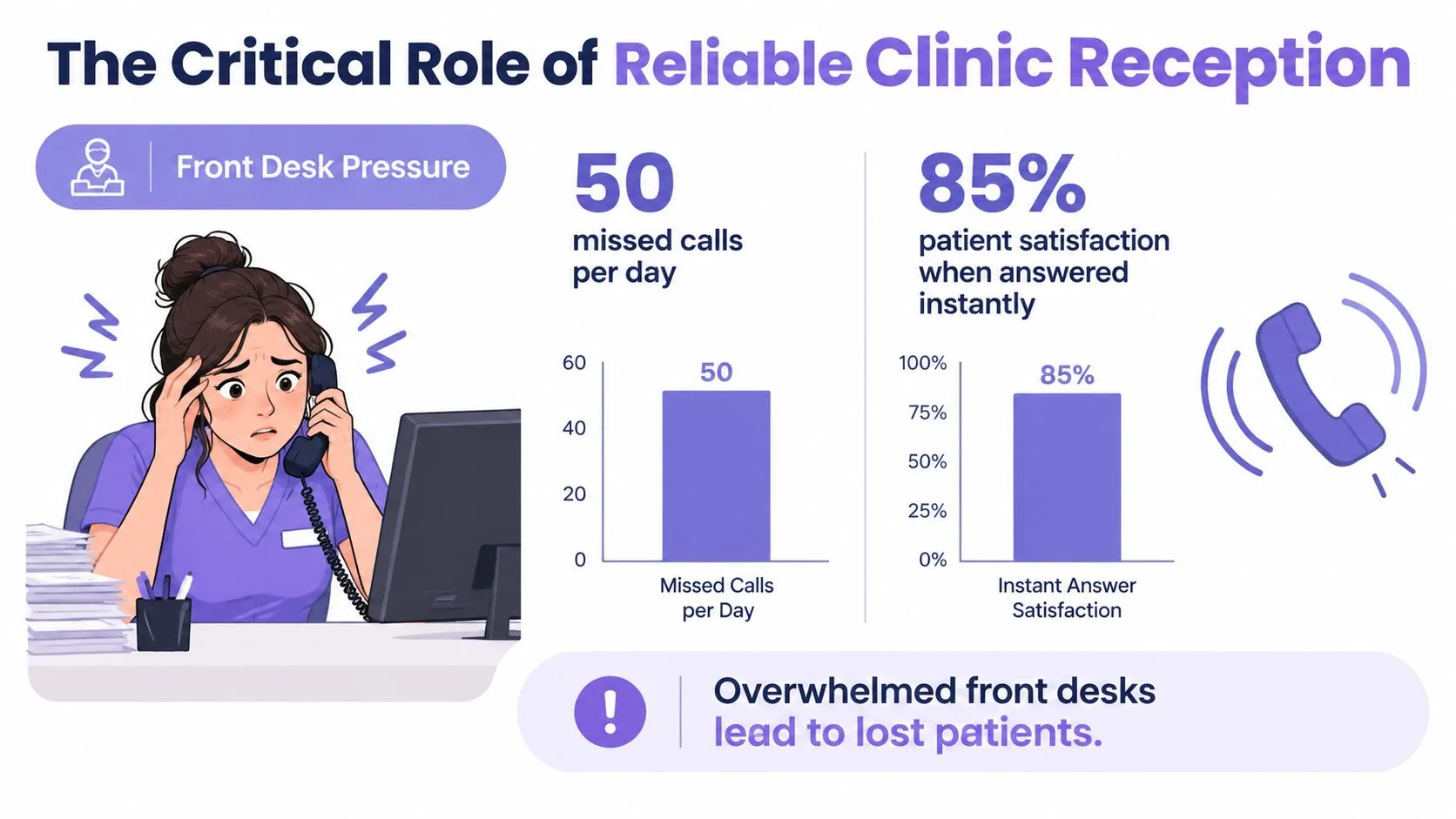
The access problem is larger than a single overloaded shift. The Australian Bureau of Statistics patient experience data reports that 26.6% of Australians delayed or did not see a GP when needed in 2024–25, while 26.0% waited longer than they considered acceptable for a GP appointment. Those figures don't prove that unanswered calls caused the delays, but they show why scheduling and communication deserve operational attention.
Why phone access still matters
Australian healthcare has normalised remote contact without becoming phone-free. The Australian Government's 2023 Telehealth Review found that telehealth represented 17.2% of all Australian healthcare consultations in 2022, including more than 39.9 million phone consultations and over 5.6 million video consultations. The same review records the RACGP position that approximately 20% of GP consultations were conducted through telehealth, with 94% occurring by telephone.
That matters for reception because patients don't always want, or know how, to use a portal. A phone-first service can handle appointment requests, cancellations, rescheduling, routine enquiries and carefully defined administrative triage without forcing callers through another digital channel.
Operational rule: Treat the telephone as a core access channel, not an overflow problem to be solved only after the front desk is busy.
A useful virtual receptionist should therefore do more than announce opening hours. It should capture the reason for the call, collect only the information needed for the next step, complete routine diary actions, and route sensitive matters to trained staff. It also needs reporting that helps the practice understand unanswered calls, after-hours demand, abandoned interactions and completed bookings.
The right question isn't, “How many calls did the system answer?” It's, “How many patient requests reached a correct and safe outcome without creating rework for the team?”
Comparing Live Operators, AI Voicebots, and Hybrid Models
A patient calls after hours with chest discomfort and asks to move tomorrow's appointment. One request may require immediate clinical escalation, while the other is administrative. The quality of a virtual receptionist depends on whether it can separate those paths safely, record the right context and involve a person when the rules require it.
The three main models place that responsibility in different hands. Live operators provide human judgement, AI voicebots deliver consistent automation, and hybrid services combine automated handling with human escalation. None is automatically suitable for a medical practice. Outcomes depend on configuration, integration, staff oversight and the boundaries set around clinical conversations.
| Feature | Live Operator | AI Voicebot | Hybrid Model |
|---|---|---|---|
| Routine booking | Human-led | Automated within approved rules | Automated, with human fallback |
| Complex conversation | Stronger contextual judgement | Limited by configuration and confidence | Escalates to a person |
| After-hours coverage | Depends on service hours | Broad coverage possible | Broad coverage with defined fallback |
| Clinical-risk handling | Person can assess, but training varies | Must use strict escalation logic | Automation identifies, human handles |
| Data capture | Flexible, may introduce transcription errors | Structured and consistent when configured | Structured capture with review option |
| Scalability | Capacity depends on staffing | Handles concurrent demand more readily | Scales routine work while reserving people for exceptions |
| Main operational risk | Inconsistent instructions or handoff | False reassurance, wrong intent or failed transfer | Poorly designed boundary between automation and staff |
Live operators
A live answering team helps when callers need empathy, unusual explanations or complex coordination. A trained operator can recognise that a request falls outside a script and transfer it to the appropriate person. The practice still needs to verify training, privacy controls, service hours, transfer quality and the way information is recorded.
Human involvement does not remove clinical risk. Operators should not provide medical advice because a caller asks for it. The service needs a firm boundary between administrative intake and clinical decision-making, with documented escalation steps and review of handoffs.
AI voicebots
An AI voicebot can handle routine calls consistently, collect structured details and complete approved booking workflows. It may suit overflow periods and after-hours contact, provided the practice controls its knowledge base, permissions and escalation paths. A bot that confidently misinterprets a medication request presents greater risk than a transparent system that states its limits and transfers the caller.
Teams assessing the wider technology should distinguish a general AI voice agent approach for support teams from a healthcare receptionist workflow. Medical callers require narrower permissions, clearer audit trails and a reliable human override. The practice should also establish where call recordings, transcripts and extracted patient details are stored, who can access them and how long they are retained.
Hybrid models
Hybrid reception is often the practical middle ground. Automation handles opening hours, practitioner availability, routine appointment changes and message capture. Staff receive calls involving urgent symptoms, distressed callers, uncertain identity, medication questions, minors, language barriers or anything outside the approved administrative scope.
The transfer must include context. If a patient repeats their name, reason for calling and urgency after waiting for a person, the system has shifted work rather than removed it. Test transfers with realistic scenarios, including incomplete answers, ambiguous intent and callers who change their request mid-conversation.
Be wary of vendor case studies citing retention figures from unrelated industries, such as marketing-agency client retention. A high retention rate for answering a dental clinic's calls says nothing about booking accuracy, privacy controls or escalation safety in a medical practice. Demand healthcare-specific outcome data and examine how the vendor defines a successful interaction.
Appointment Booking and Practice Management Integration
A receptionist that answers every call but can't safely update the practice diary is a message-taking service, not a complete booking solution. Australian practices need the system to read real-time availability, apply appointment-type rules, and write the final action back to the practice-management system without double entry.
CommBank's 2024 Australian patient-experience research found that 39% of patients still make healthcare bookings by telephone first. It also found that 19% considered the booking process too difficult, while another 19% said practice hours were unsuitable. A phone service that supports booking and extended coverage can address part of that access friction, but only if the transaction ends in a valid appointment.
Read access isn't enough
Read-only calendar access lets a voicebot describe availability. It doesn't let the system complete the job. A well-built integration should support:
- Authenticated connectivity: Use an authenticated API or standards-based connection to the practice-management system.
- Real-time availability: Check the current diary rather than relying on a periodically copied calendar.
- Bidirectional transactions: Create, modify and cancel appointments through the connected workflow.
- Patient matching: Confirm identity carefully enough to avoid duplicate records or bookings against the wrong patient.
- Audit logs: Record who or what made the change, when it happened and which appointment type was used.
- Fallback queues: Hold an exception for staff when a connection fails, identity is uncertain or the requested slot isn't valid.
The Australian Digital Health Agency's interoperability work, discussed in the implementation section below, gives useful language for assessing whether a vendor has genuine system connectivity or only a superficial calendar display.
Test the final diary state
During evaluation, don't stop at a successful conversation. Test a new booking, a cancellation, a reschedule, an unavailable practitioner, a patient with a similar name, and an interrupted call. Then inspect the practice-management record.
The success measure should be the percentage of interactions that reach a verified final diary state without manual re-entry. Track exceptions such as failed writes, duplicate records, invalid appointment types and staff corrections. A vendor that reports only call duration or completed conversations may hide the administrative burden created after the call.
For teams comparing booking connectors outside healthcare, Croft's Calendly integration setup illustrates why the connection method matters. Australian clinics should apply the same scrutiny to Best Practice, MedicalDirector and other systems, including the medical practice software used by Australian clinics, rather than treating every “integration” label as equivalent.
Navigating Privacy, Consent, and Data Security
Every virtual receptionist creates a data journey. A caller may provide a name, contact details, appointment history, Medicare-related information, symptoms or a voice recording before a staff member ever joins the conversation. The practice remains responsible for understanding where that information travels and what the vendor does with it.
The OAIC guide to health privacy explains that health information is subject to Privacy Act obligations. General assurances such as “secure platform” aren't enough for a practice manager deciding whether patient conversations can be processed by an external service.

Map the information before signing
Ask the vendor to document the complete path from phone call to practice record. The answer should cover:
- Collection: What information is requested, and is the system limited to approved administrative purposes?
- Processing: Which provider, model or subprocessor handles speech, transcripts and booking actions?
- Hosting: Where is information stored and processed, including backups and disaster-recovery environments?
- Training: Are recordings, transcripts or extracted data used to train models? Can that use be disabled?
- Retention: How long are recordings, transcripts, logs and failed interactions retained?
- Access: Which vendor and clinic roles can review conversations, and are access events logged?
- Disclosure: What happens if a subprocessor changes, a breach occurs or a patient requests human assistance?
- Deletion: Can the practice request deletion or apply a retention policy that matches its obligations?
Australian clinical guidance also emphasises patient communication about AI use, confidentiality, consent and secondary data use. A patient should know when an automated system is handling the interaction and how to reach a person.
Australian hosting is only one control
Australian storage may matter, but it doesn't prove compliance by itself. Purpose limitation, access controls, retention, subcontractors, encryption, breach response and accurate patient notices all contribute to the risk profile.
The data protection practices resource from Openbase can help teams think beyond a vendor's marketing summary, but the clinic still needs written answers specific to the proposed workflow. Ask for the data-processing terms, security documentation, model-training settings and a sample audit record before production use.
Privacy test: If the vendor can't draw the data path clearly, the practice can't assess the risk clearly.
This work supports access as well as compliance. The ABS figures cited earlier show that patients already face barriers to timely GP care. Privacy controls shouldn't make phone access unusable, but convenience can't justify collecting more clinical information than the workflow needs.
Clinical Risk Management and Escalation Protocols
The most important measure of a medical virtual receptionist isn't its answer rate. It's what happens when a caller says something that doesn't belong in an automated booking flow.
A safe service starts with a deliberately narrow scope. It can identify the reason for contact, manage approved administrative tasks and gather information for staff. It shouldn't diagnose, recommend treatment, interpret results or reassure a caller about symptoms unless a qualified clinician has taken over.
Define the boundary cases
Before launch, the practice should write escalation rules in plain language. These should cover:
- Possible emergencies: Direct the caller to emergency services or the practice's approved urgent pathway, then escalate according to the clinic's procedure.
- Urgent or worsening symptoms: Stop routine automation and transfer to an appropriate staff member or documented clinical pathway.
- Medication and test-result requests: Capture the request without offering advice, then route it to authorised practice staff.
- Distress or vulnerability: Use a calm handoff process for distressed callers, minors, people needing an interpreter and callers who can't complete the automated flow.
- Uncertain intent: Ask a limited clarifying question, then transfer rather than guessing.
- After-hours contact: State the available service boundaries and provide the clinic's approved urgent-care instructions.
The Australian Health Practitioner Regulation Agency guidance on artificial intelligence in healthcare says practitioners should inform patients when AI is used, consider patient concerns, protect confidentiality and understand whether patient data is used to train models. The Australian Commission on Safety and Quality in Health Care similarly places responsibility on clinicians to explain an AI system's purpose, scope, benefits and risks.
Audit the handoff, not just the call
Every escalation should create a reviewable event. Record the reason for transfer, the information captured, the destination, whether the handoff succeeded and whether the caller had to repeat details. Review false reassurance, abandonment, misrouting and failed transfers as safety events, not merely service-quality complaints.
Cost and risk meet here. A cheap system that sends uncertain calls into a dead end can increase callbacks, staff corrections and complaints. A more controlled workflow may handle fewer intents but produce better operational results because staff receive the right work with usable context.
Practices assessing a broader healthcare chatbot workflow should apply the same discipline to voice. The channel changes, but the requirement doesn't: automation must support human oversight rather than obscure it.
Cost Analysis and Implementation Considerations
A sound business case begins with the work the clinic needs removed, not the subscription price. Compare the service against current unanswered calls, staff time spent on routine changes, after-hours requests, correction work and the opportunity cost of a receptionist interrupted throughout the day. Clinic-specific call analytics are more defensible than generic missed-call benchmarks.
Pricing may be structured around minutes, calls, interactions, monthly allowances, setup or human escalation. Those labels aren't directly comparable. Ask what counts as a billable interaction, whether transfers continue the charge, how failed bookings are treated and whether integration work is included.
Choose the model by operational fit
| Clinic situation | More suitable starting point | Conditions for success |
|---|---|---|
| Lower complexity and occasional overflow | AI voicebot | Narrow administrative scope and reliable human fallback |
| Regular call pressure with sensitive conversations | Hybrid model | Clear escalation rules and contextual transfer |
| Complex coordination and callers needing judgement | Live operator or hybrid | Trained staff, privacy controls and PMS documentation |
| Multiple practitioners or locations | Hybrid or configurable automation | Central rules, diary permissions and exception reporting |
Use the Australian Digital Health Agency's definition of interoperability as a practical benchmark. It describes information moving within and between systems without special effort by the user, with standards enabling that exchange. Its national interoperability survey identifies faster access, better care coordination and time saved gathering information as leading benefits, as outlined in the 2025 interoperability survey.
That means a vendor should demonstrate the complete workflow, not just a polished call. Test booking, cancellation, rescheduling, identity matching, failed connections, staff review and audit logs before committing.
Roll out in controlled stages
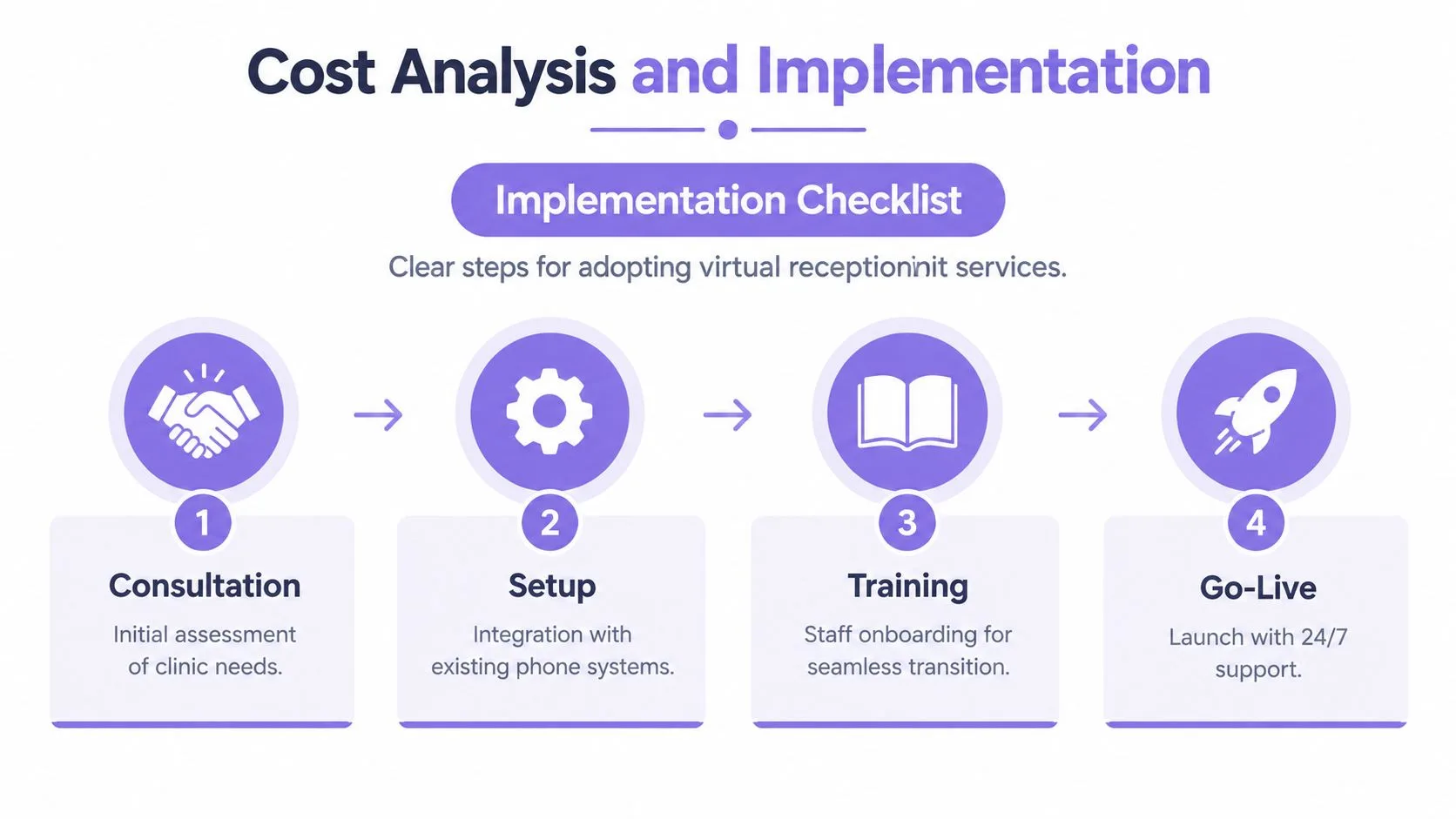
- Consultation: Document call reasons, appointment types, opening hours, urgent pathways, language needs and current failure points.
- Setup: Connect the phone service and practice-management system, then apply the minimum permissions needed for diary actions.
- Training: Brief reception and clinical staff on escalation, exception queues, patient disclosure and transcript review.
- Go-live: Start with monitored traffic, review interactions, correct the knowledge base and expand only when diary accuracy and handoff quality are acceptable.
The video below provides additional context for teams considering voice automation.
TOOLii offers Australian clinics voicebot and appointment-booking tools that can handle routine inbound calls, book or reschedule appointments, transfer urgent calls and connect with practice-management workflows. If your practice is ready to test a safer reception process, visit TOOLii to review how its healthcare automation approach could fit your phone, diary and escalation requirements.