
It's Monday morning, your reception team is already on the phones, and patients are waiting at the desk. A caller wants to move an appointment, another needs help with a referral, and someone mentions chest tightness before the receptionist can finish the greeting. You need more answering capacity, but you also need to know who will recognise the call that must leave the booking queue.
Table of Contents
- The Call Your Practice Is Missing Right Now
- Why Australian Practices Need a Different Approach
- Human Virtual Receptionists vs AI Voicebots Compared
- How PMS Integration Changes the Equation
- Where the Clinical Line Must Be Drawn
- Privacy, Consent and the 2026 Compliance Shift
- Which Model Fits Which Australian Practice
The Call Your Practice Is Missing Right Now
The immediate temptation is to buy relief. Hire another receptionist, divert calls to an offsite answering team, or install an AI voicebot that handles routine requests.
Each option can help. None removes your responsibility for what happens during the conversation.
For a patient rescheduling a routine appointment, success means finding an eligible slot and recording the change correctly. For someone describing concerning symptoms, success means following your practice's approved escalation pathway, not completing a booking as quickly as possible.
That distinction should drive your purchasing decision.

Decide which work you're moving
An onsite receptionist does more than answer calls. They notice a distressed patient at the counter, check an instruction with a nurse, and manage paperwork that hasn't reached the clinical system. Remote answering won't replace those physical responsibilities.
Before comparing suppliers, separate the work:
- Routine transactions: Bookings, cancellations, opening hours and directions.
- Exceptions: Unclear appointment types, referral questions and identity mismatches.
- Clinical escalation: Conversations requiring a qualified practitioner's attention.
For a technical starting point, UpTime Web Hosting's practical hints for business phones are a useful resource to consult when reviewing your phone setup. Keep that infrastructure review separate from deciding who may handle patient information.
Likewise, review an appointment-setting virtual assistant against the work you intend to delegate, rather than treating appointment setting as the whole reception role.
Practical rule: Buy capacity for a defined task, not permission for an unfamiliar operator or system to improvise.
Your practice manager should own the operating rules, your clinical lead should approve clinical escalation, and your IT or integration lead should verify system access. Assign those responsibilities before anyone changes the call routing.
The right question isn't whether a virtual receptionist costs less than another employee. It's whether the proposed arrangement gives patients a dependable answer without leaving staff unclear about who decides what happens next.
Why Australian Practices Need a Different Approach
Australian practices need reception systems designed around how patients contact them, not around a generic business answering script.
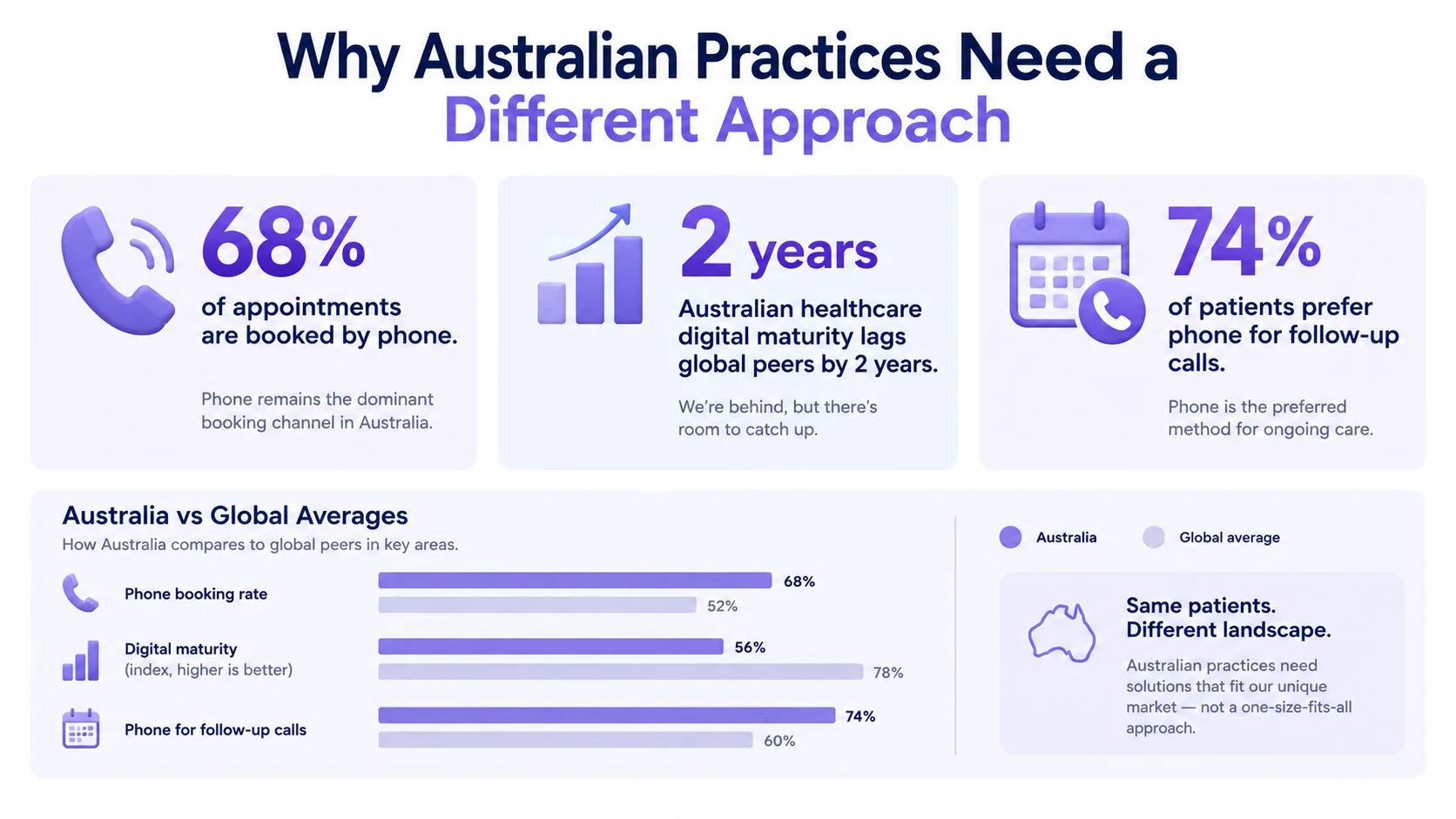
The scale is substantial. In 2023, 22 million Australians visited a GP, and GPs delivered more than 169 million health services, averaging 7.6 services per patient, according to the RACGP's Australian general-practice demand summary; the associated Australian booking evidence identifies phone as the most-used channel, while 54% of patients preferred online booking and appointment management when available, compared with 37% who preferred calling.
The operational implication is straightforward: don't make patients choose between a functioning telephone service and convenient digital booking. Design both around the same appointment rules.
Connect channels without forcing a migration
A patient might book online, call to change the appointment, and then receive a reminder by message. Your receptionist arrangement should preserve that continuity.
Otherwise, staff inherit competing versions of the same request. A cancellation captured by phone but not reflected in the appointment book leaves an apparently occupied slot. A web booking that the answering service can't see creates unnecessary checking and callbacks.
Use the visual below as an illustration of channel planning, not as a source of numerical purchasing benchmarks.
For virtual receptionists in Australia, local fit should mean more than an Australian-sounding voice. Ask the supplier to work through your actual patient pathways:
- Appointment vocabulary: Can the service distinguish your booking categories without inferring a clinical need?
- Patient communication: How does it handle unfamiliar names, different accents, interpreter requests and callers who struggle with digital tools?
- Practice conventions: Can it follow your public-holiday arrangements, referral requirements and approved Medicare-related administrative wording?
- Channel ownership: Who monitors secure messages, web requests and calls that need follow-up?
Keep the existing workflow visible
Don't assume that digitised records mean every reception process is already connected. Ask staff where they still copy information between systems, check handwritten instructions or chase messages.
Your implementation should address those gaps explicitly. A receptionist that handles the telephone beautifully but leaves unresolved requests in an unattended inbox is not a complete solution.
Choose a local workflow fit over a long feature list. Patients need the correct next action, and staff need a reliable record of it.
Human Virtual Receptionists vs AI Voicebots Compared
My recommendation is to compare exception handling before voice quality. A polished greeting tells you little about how a service behaves when a patient changes their mind, becomes distressed or disputes the available appointment.
Neither model deserves a blanket endorsement. Use the comparison below as a procurement checklist, not a promise that every supplier delivers these capabilities.
Human vs AI Receptionist at a Glance
| Criterion | Human Offsite Receptionist | AI Voicebot |
|---|---|---|
| Call-answer coverage | Verify roster, queue capacity and overflow arrangements | Verify concurrency, outages and fallback routing |
| Cost structure | Check service fees, usage charges and extras | Check usage, implementation, integration and support costs |
| Consistency and training | Requires practice-specific induction and supervision | Requires approved rules, testing and change control |
| Language and accent handling | Can clarify conversationally, subject to operator skills | Must demonstrate recognition and accessible fallback |
| Escalation behaviour | Can notice ambiguity but still needs explicit boundaries | Needs tested triggers and a functioning handoff |
| PMS integration depth | May book directly or merely pass messages | May write bookings directly or only capture requests |
Judge the service under pressure
Call-answer coverage. Ask an offsite human service what happens when its operators are busy. Ask an AI supplier what happens when its telephony or application connection fails. Judge coverage by the fallback that works, not the advertised availability.
Cost structure. Request a quote covering your call mix, including lengthy conversations, transfers and booking changes. Add the staff time needed to reconcile messages or correct errors. A low subscription price doesn't establish a low operating cost.
Consistency and training. Human operators need current instructions and a named contact for uncertainty. Voicebots need controlled scripts, approved knowledge and regression testing after changes. I'd favour the supplier that can demonstrate disciplined updates over the one promising effortless setup.
Expressify AI's automated voice answering for small businesses is a useful general-business reference when exploring the category. A clinic evaluation still needs patient-specific tests that a general answering demonstration won't cover.
- Language and accent handling: Test interruptions, background noise, spelling corrections and interpreter requests. Don't accept a voice sample as evidence of comprehension.
- Escalation behaviour: Require a live demonstration of a difficult handoff. The caller should know what's happening, and the receiving staff member should receive the relevant context.
- PMS integration depth: Establish whether either service completes authorised transactions or merely creates another work queue. Reserve judgement until you've inspected the resulting record.
A human voice doesn't guarantee sound judgement. An automated answer doesn't guarantee a resolved request.
For emotionally complex conversations, I'd lean towards trained human handling. For repetitive administrative transactions, I'd consider automation with a tightly defined scope. A hybrid model can serve both needs, provided the handover is staffed and someone owns unresolved calls.
Don't let a vendor force a binary choice when your workload isn't binary.
How PMS Integration Changes the Equation
A receptionist hasn't finished booking an appointment until your practice-management system records it. A message saying that a patient requested a slot is not a booking.
Use Best Practice as a reference system in demonstrations, or substitute your actual PMS. Ask the supplier to show the complete transaction, including failure handling, rather than displaying a calendar that looks connected.
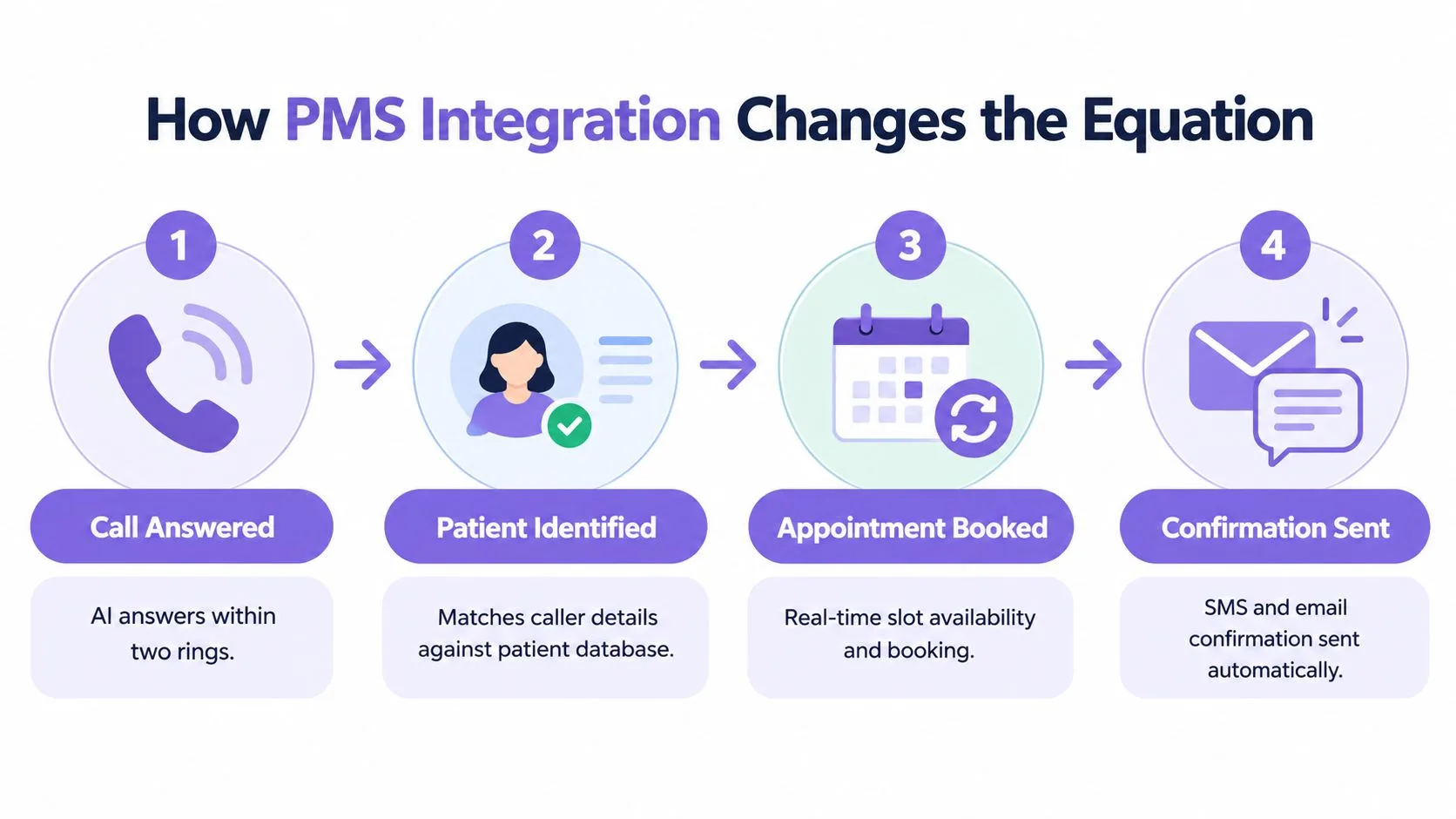
The process illustration below shows the intended sequence. Treat response-time and confirmation claims as capabilities to test, not guaranteed service levels.
Follow the transaction through
Start with patient matching. The service should use your approved identity process and validated identifiers before accessing or changing an existing record. Similar names or uncertain details should produce a verification task, not an automatic new patient record.
Next, inspect appointment eligibility. The system should apply configured rules for practitioner, location, duration and appointment category. Staff should approve those rules; the receptionist shouldn't invent them from a symptom description.
Then watch the booking write-back. The service must receive confirmation that the PMS committed the transaction before telling the patient it succeeded. If the connection fails, the wording should clearly distinguish a captured request from a confirmed appointment.
Finally, inspect the confirmation workflow:
- Correct destination: Send messages only through approved contact details and communication preferences.
- Accurate status: Trigger confirmation from the committed appointment state.
- Visible failure: Put unsuccessful writes or messages into an assigned staff queue.
A review of GP practice-management software can help frame the system discussion. SignalZen's AI support app integrations offer a separate reference point for integration questions, but support-app connectivity should never be mistaken for validated clinical PMS access.
Test the awkward cases
Ask for demonstrations involving a cancelled slot, conflicting booking requests, a changed practitioner roster and an interrupted connection. Inspect both the patient-facing response and the staff-facing record.
A visual demonstration can support that review, but it can't replace testing against your own configuration.
Require permissions appropriate to the delegated task. Booking access shouldn't become unrestricted record access.
If the supplier can't show what happens when a transaction fails, don't give it authority to confirm appointments. Start with request capture until the integration is proven.
Where the Clinical Line Must Be Drawn
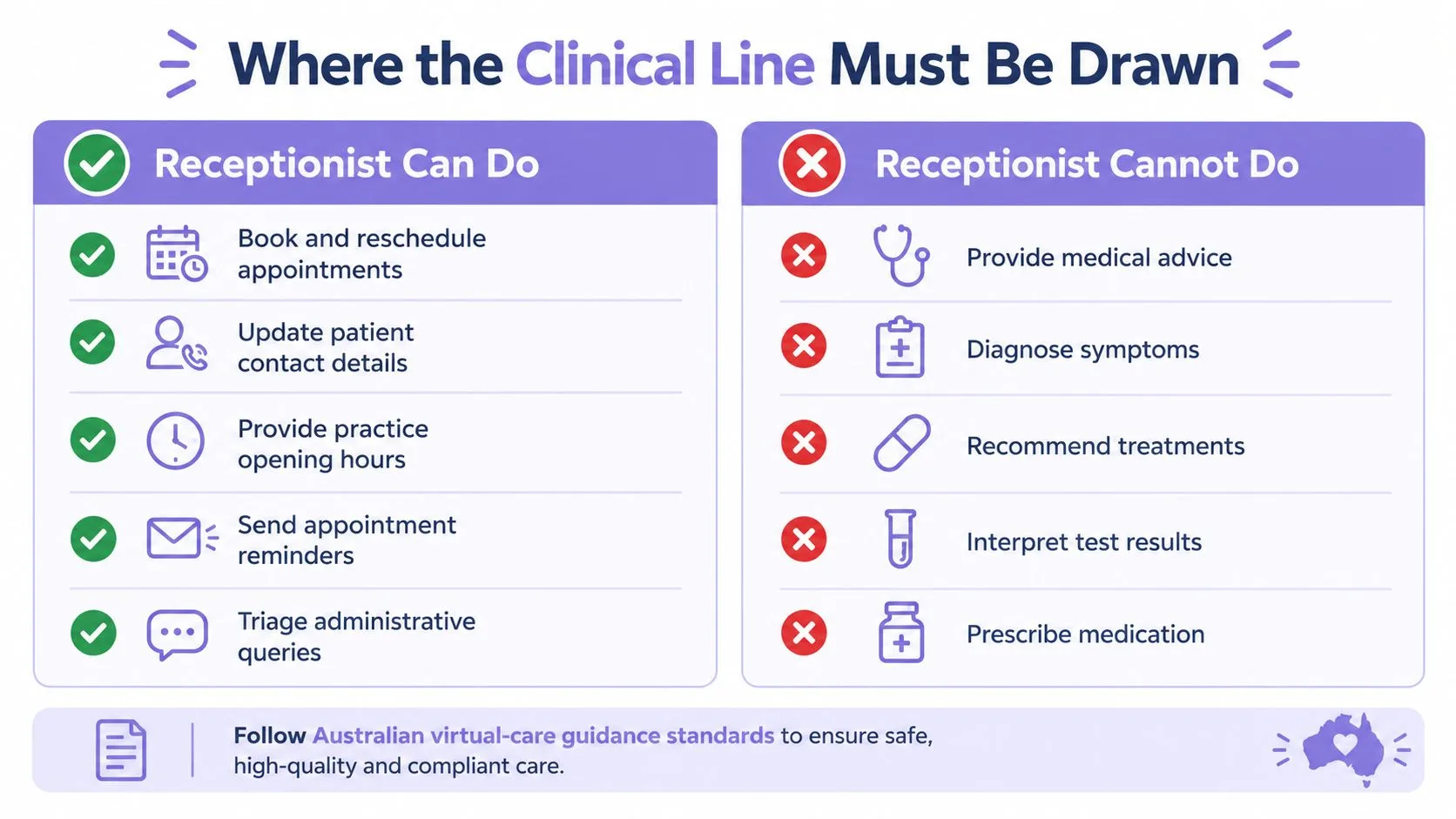
Administrative routing is not clinical triage. Reception staff and voicebots can help a caller reach the appropriate person, but your operating model must not turn that assistance into unsupervised diagnosis or advice.
Ahpra's guidance for practitioners providing virtual care says technology must be clinically appropriate, meet patient needs, protect privacy and support informed consent. Those principles support a clear operational boundary; they aren't blanket permission for a receptionist to assess medical risk.
Define actions, not vague intentions
Authorise concrete administrative tasks. These can include identifying callers, recording their stated concerns for staff review, applying approved appointment rules and transferring conversations through a clinician-approved pathway.
Keep diagnosis, treatment recommendations, interpretation of results and individual medical advice outside the receptionist's scope. That boundary applies to an offsite human operator as well as an AI system.
An Australian primary-care access study covering 184 general practices found that 10.5% didn't answer a test telephone call because it rang out or diverted to a message service. That makes call-answer coverage worth measuring, but answering a call is only the first service outcome.
Track abandonment, successful authorised bookings, failed transfers and unresolved requests too. A service that answers promptly but strands an urgent caller has not passed the test.
Put escalation through a realistic rehearsal
Ask your clinical lead to approve scenarios and exact actions for the following. These are testing categories, not a complete clinical protocol:
- Chest pain or tightness: Test direct and indirect wording, including a caller mentioning symptoms while asking for a routine appointment.
- Paediatric distress: Establish how concerns about a child reach qualified assessment without automated reassurance.
- Mental health crisis: Test distressed speech, ambiguous wording and what happens if a transfer fails.
- Medication questions: Separate administrative requests from questions about doses, adverse effects or whether to stop treatment.
- After-hours uncertainty: Use approved instructions that accurately reflect available services. Don't imply a clinician is monitoring messages when nobody is.
Boundary test: If the system's response could persuade someone to delay seeking care, your clinical lead needs to review it before deployment.
Speech-recognition failures and incomplete identity checks also need explicit handling. Preserve uncertainty in the staff record rather than turning unclear speech into a confident summary.
Patients must be able to request a human. Staff must be able to inspect what the service understood and what it did. Without both, your practice can't meaningfully supervise the clinical boundary.
Privacy, Consent and the 2026 Compliance Shift
Australian hosting and encryption aren't complete compliance answers. They address parts of the technical arrangement, not whether your clinic has authorised the collection, use and disclosure of patient information appropriately.
The Australian Government's AI-health legislation and regulation review states that the Privacy Act 1988 and Australian Privacy Principles apply across AI training, testing and deployment; the upcoming requirements taking effect on 10 December 2026 mean entities using personal information in automated decision-making that could significantly affect a person's rights or interests must describe relevant information and decisions in their privacy policy.
Don't wait for that commencement date to understand what your system does. Map its decisions before deployment and obtain advice on which obligations apply to your configuration.
Separate scheduling from access decisions
Offering slots that meet approved booking rules differs from using patient information to determine priority, refuse a request or materially influence access to care. The latter deserves closer legal and clinical review.
An Australian digital-health guide to telehealth also makes clear that remote care retains privacy and information-security requirements, including confidentiality, consent and security of medical records. Moving the conversation onto a new channel doesn't make patient information less sensitive.
Write a system-purpose statement in plain English. Explain what the receptionist collects, what it changes, what it cannot decide and who reviews exceptions.
Then document the data path:
- Collection and notice: Identify the information needed, how callers learn they're interacting with automation, and when recording or other processing requires consent.
- Vendor access: Record suppliers, subprocessors, storage locations and contractual restrictions on secondary use or model training.
- Security controls: Specify role-based permissions, access logging, encryption in transit and at rest, and incident responsibilities.
- Retention and deletion: Distinguish recordings, transcripts, operational logs and clinical records. Assign approved retention rules to each.
- Human assistance: Give patients an accessible alternative and staff a documented review process.
Make oversight a staff responsibility
A transcript archive is not an oversight programme. Assign someone to review failed transactions, disputed summaries and escalation outcomes, with a route for correcting records and changing unsafe instructions.
Use test identities during demonstrations wherever possible. Don't expose real patient details just to discover whether a vendor's workflow works.
Treat your broader AI-for-healthcare assessment as an operational governance exercise, not just a technology purchase. Ask your privacy adviser to review notices, contracts and automated-decision disclosures against the actual configuration.
The decisive question is whether your clinic can explain and control the system's use of patient information. A security badge can't answer that for you.
Which Model Fits Which Australian Practice
Choose the model around your unresolved work, patient mix and available supervision. These are situational recommendations, not claims that a particular practice type always needs the same service.
Match the service to the workload
For a solo GP clinic with predictable demand, I'd start with trained human overflow cover if calls frequently involve familiar patients, unclear requests or sensitive conversations. Add automation only where the task is well defined and staff can manage exceptions.
A multi-site specialist group should prioritise appointment-rule accuracy and coordinator access. Where referral conditions, practitioner preferences and procedure preparation complicate scheduling, retain human booking oversight. Automate narrower tasks after the rules are documented.
For a high-volume allied health provider with repetitive scheduling, an integrated voicebot is a reasonable candidate for routine changes and bookings. Preserve human handling for unusual requests, accessibility needs and disputed outcomes.
- Daytime hybrid: Let automation handle authorised transactions while staff receive exceptions.
- Offsite human cover: Use a trained team for overflow or contracted after-hours answering, without assuming its operators provide clinical assessment.
- Fallback ownership: Name the person responsible when either service can't finish the request.
Choose for your actual digital maturity
National digital-health research covering 1,164 practices across 10 Primary Health Network regions reported an average maturity score of 69.5 out of 100, with no domain averaging above 80. Don't assume your existing systems and channels are ready just because they're digital.
Make the final decision after a controlled pilot. Compare completed work, patient difficulty, staff rework and escalation reliability, then expand only the tasks that perform safely.
TOOLii offers healthcare voice automation and appointment-management tools that connect with established practice-management systems. Visit to discuss your routine call workload, request a demonstration against your booking rules, and establish the integration and human-handoff requirements before changing your reception model.