
You've got a full waiting room, a phone that won't stop ringing, and an 18-minute Tuesday morning slot that already feels shorter than it should. The patient in front of you doesn't have one neat problem, either, they've brought a symptom, a script request, a follow-up question, and a worry they only mention as they stand up to leave. A general practitioner consultation in Australia is really that whole moving system, not just the few minutes where the GP and patient are face to face.
That's why the consultation has to be understood as clinical work, documentation work, and operations work at the same time. If any one of those layers is clumsy, the rest of the visit suffers, even when the doctor is sharp and the patient is well prepared.
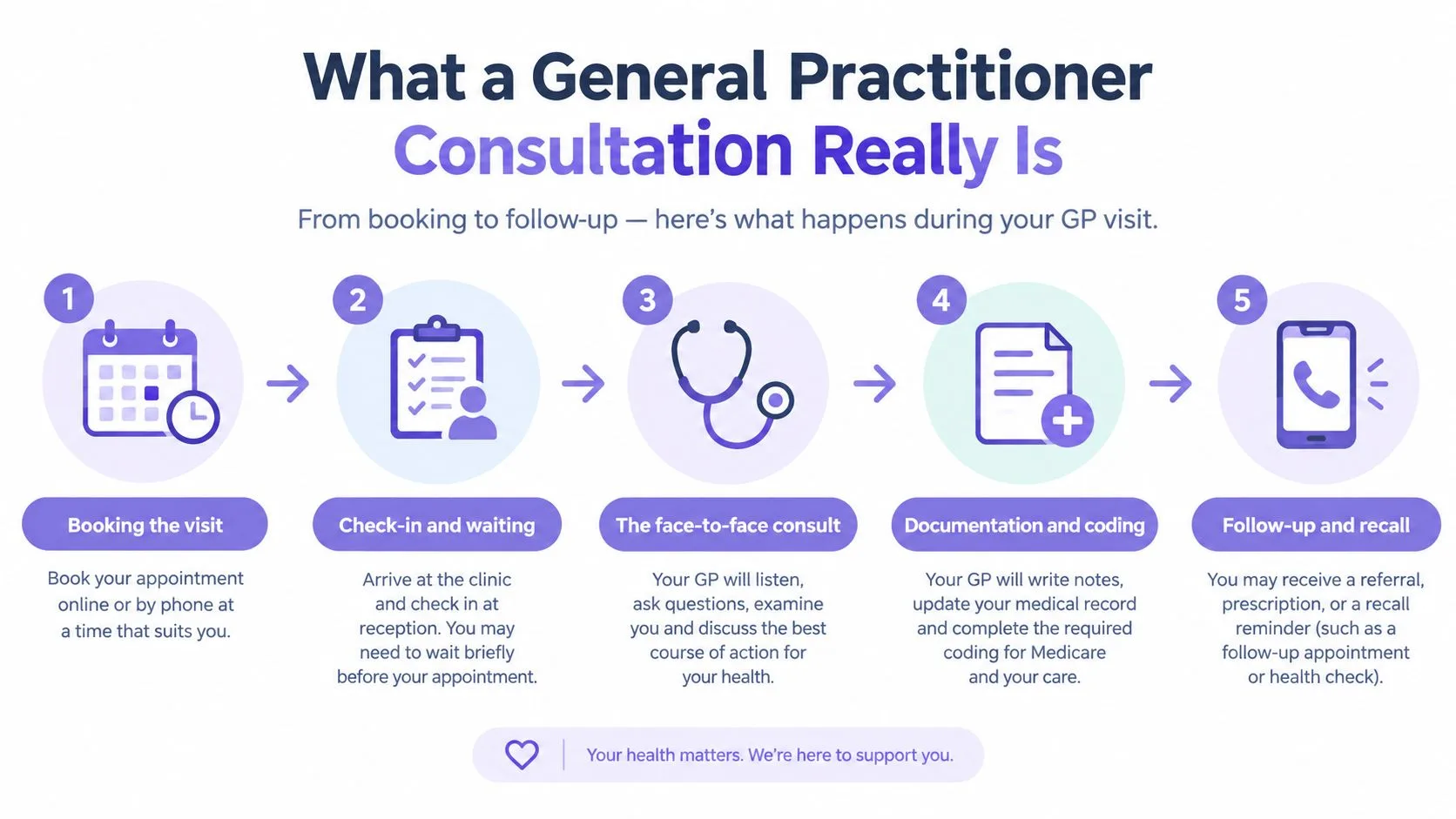
Table of Contents
- What a General Practitioner Consultation Really Is
- Before, During and After the Consultation
- How Complex a Standard GP Consultation Is
- Telehealth Versus In-Person Consultations
- Billing, Rebates and Patient-Facing Cost Clarity
- Why Documentation and Workflow Automation Matter
- Putting It Together in Your Practice
What a General Practitioner Consultation Really Is
A general practitioner consultation often starts before the patient steps through the door. Someone books online or by phone, reception checks eligibility and timing, and the clinical team decides whether the visit should be face to face, by telehealth, or handled another way. By the time the GP opens the file, triage, earlier notes, pending results, and the day's appointment pattern have already shaped the visit.
The consultation is a workflow, not a single event
Inside the room, the GP listens, asks questions, examines when needed, decides on management, and records what matters for the next step. After that, the clinic still has referrals, scripts, recalls, billing, and patient communication to handle. In a busy practice, those after-actions can matter just as much as the conversation itself.
Practical rule: if you only think about the time the GP spends speaking with the patient, you'll underestimate the full load on the clinic.
That is why a general practitioner consultation is best understood as a repeatable workflow with a clinical core. The patient experiences one visit. The clinic experiences several linked tasks.
Why this framing matters for clinics
The Australian consultation system grew substantially over the first decade of the 2000s, with Medicare-funded general-practice consultations rising from about 101 million in 2000–01 to 116.8 million between March 2008 and April 2009, and average activity reaching 5.3 Medicare-funded services per person (AIHW summary). At that scale, the pressure point is not only whether the doctor can see the patient. It is whether the practice can move the visit cleanly through booking, care, record-keeping, and follow-up.
A useful model is a conveyor belt with a person watching each station. Booking sets the pace, the consultation creates the clinical content, and the record turns that content into something the rest of the practice can safely use. If one station slows down, the next one backs up.
Before, During and After the Consultation
A practical consultation starts with the patient's life, not the clinician's template. An older patient on several medicines might arrive with a bag of blister packs and a half-written list of questions. A parent might bring a child with three separate concerns, only one of which was mentioned when the appointment was booked. A telehealth check-in for a mental health care plan often needs the file open before the call begins, because the conversation will be shorter than the context around it.
Before the consult, the clinic is already triaging
Reception and nursing staff often do the first sorting without calling it that. They decide whether the patient needs a long appointment, whether prior results should be pulled up, and whether a message to the GP would help before the patient arrives. In an efficient clinic, that prep work reduces avoidable interruptions once the appointment starts.
The patient usually sees this as simple organisation. The clinic sees it as risk management. If the right pathology, medication history or correspondence isn't in front of the GP, the consult can still happen, but it becomes more repetitive, less decisive, and more likely to spill into the next appointment.
During the consult, the agenda expands quickly
Once the patient is in the room, the conversation rarely stays in one lane. A cough becomes a script request, then a question about a blood test, then a mention of sleep, then a request for a form. The GP has to decide what belongs in the current visit, what can wait, and what needs follow-up.
That's where good consultation habits matter. Clear agenda-setting at the start, summary statements in the middle, and a concise plan at the end save time without making the patient feel brushed off. The art is not to rush the person, but to keep the thread visible.
After the consult, the record becomes the handover
Once the patient leaves, the clinic still has to close the loop. Referrals need the right details, prescriptions need accuracy, recalls need to be set up, and any financial charge needs to match the appointment type. If the note is vague, the next clinician inherits uncertainty instead of continuity.
For a lot of clinics, that is where the hidden workload sits. The consultation feels finished to the patient, but the practice still has a trail of small actions to complete. The more complex the visit, the more valuable it is to capture the plan cleanly while the facts are fresh.
How Complex a Standard GP Consultation Is
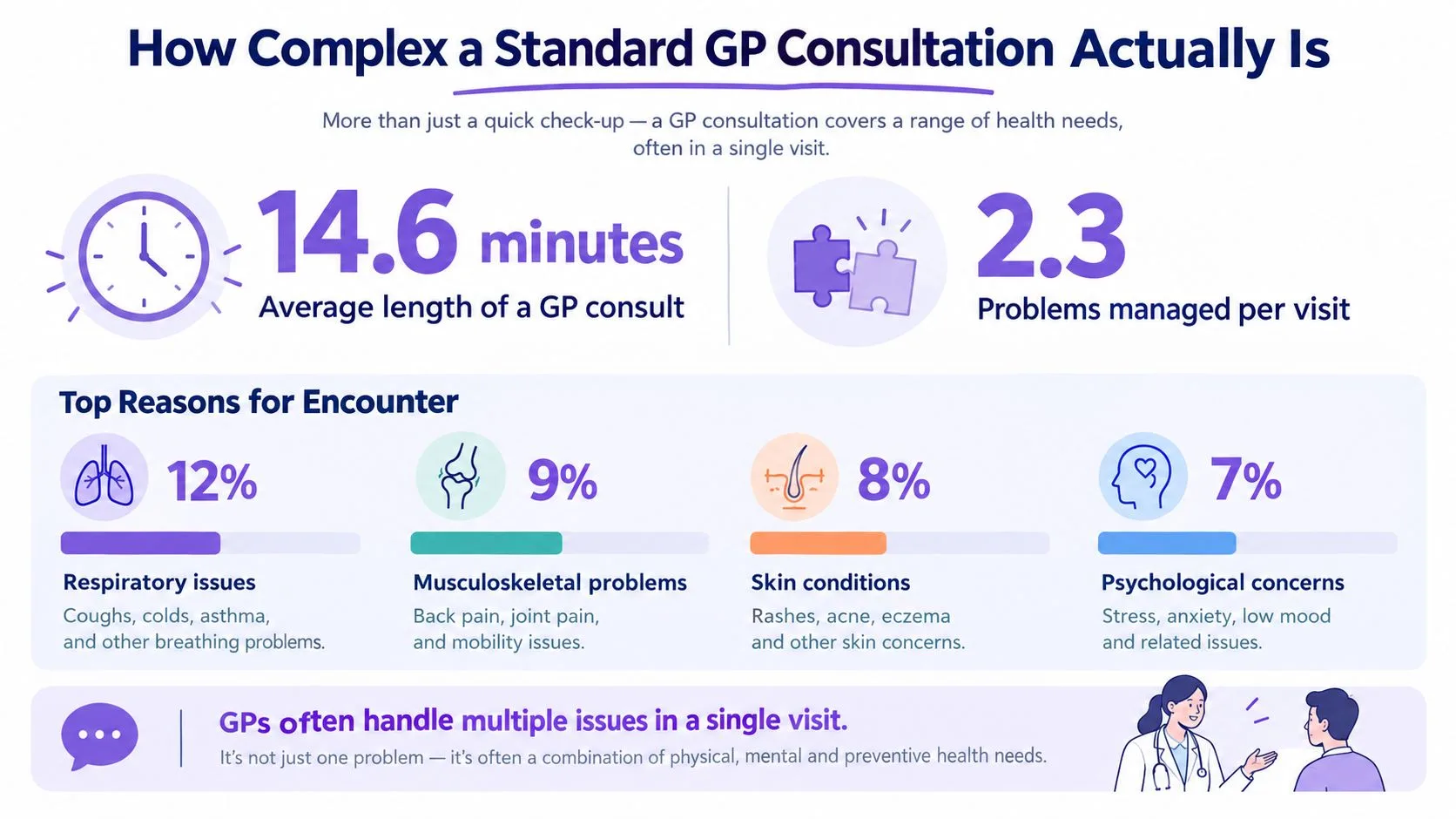
A standard consultation is rarely a single-problem transaction. In the BEACH program, the mean consultation length was about 15 minutes, with a median of 13 minutes in most years, while consultation patterns kept shifting as demand and the patient age mix changed over time (AIHW summary).
Multiple problems sit inside one short visit
The 2009–10 BEACH data show GPs managed an average of 153 problems per 100 encounters, made 13 referrals per 100 encounters, and recorded 155 reasons for encounter per 100 consultations (AIHW introduction). That is a lot of work inside a short room conversation. It also means the note has to separate what the patient said, what the GP found, and what the plan covers. A clean record is not just tidy administration, it is the handover for the next decision.
The patient mix in those encounters was broad as well. Females accounted for 57% of encounters, and patients aged under 25, 25–44, 45–64 and 65 or older each made up meaningful shares of the workload (AIHW introduction). In practical terms, the consulting room is handling very different kinds of people, conditions and communication styles throughout the day.
The time window shapes the documentation problem
A video-recorded Australian study of 54 consultations found a mean duration of 19 minutes 19 seconds, with consultations ranging from 3 minutes 35 seconds to 39 minutes 59 seconds. It also found that clinicians discussed an average of five items per consultation, with a further three items mentioned on average (RACGP AJGP article). That spread matters. A clinic cannot assume every consult is a tidy, fixed-length task.
A consultation note has to do two jobs at once. It must preserve the clinical story and keep the record usable for the next decision.
That is why generic transcription struggles if it treats every spoken phrase as equally important. A good workflow needs to recognise active problems, background detail, medication changes, investigation requests and follow-up actions without turning the whole conversation into one long blob of text. For a practice manager or clinic owner, that is the standard that matters, not just more notes faster.
Telehealth Versus In-Person Consultations
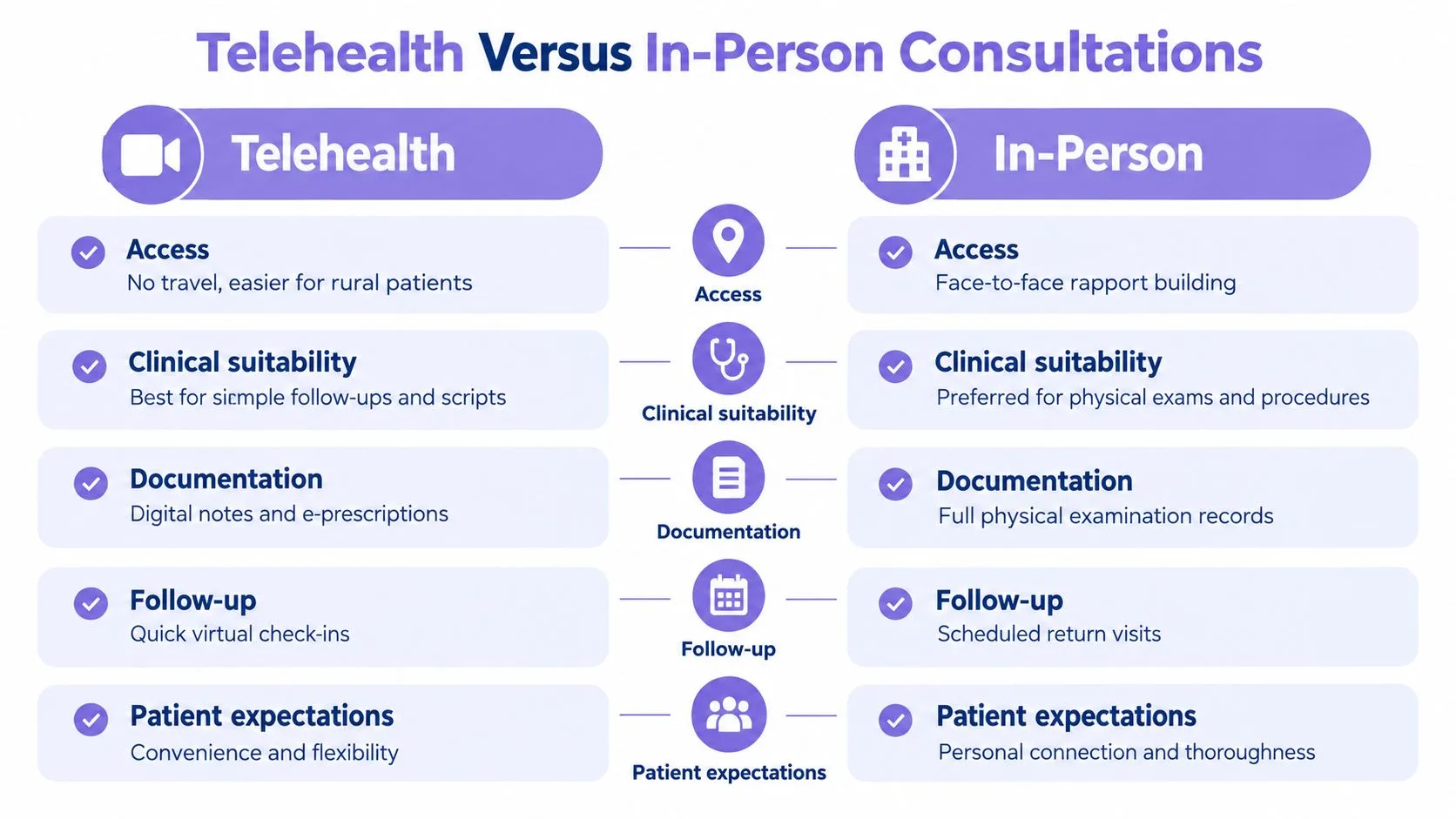
Telehealth and in-person care aren't rivals, they're tools with different strengths. A practice that treats them as interchangeable usually ends up disappointing both clinicians and patients. The better approach is to match the format to the job the appointment has to do.
The video below is useful if your team is debating how to position virtual care in everyday general practice.
The right format depends on the clinical task
| Appointment Scenario | Better Fit | Key Trade-Off |
|---|---|---|
| Simple follow-up or repeat script | Telehealth | Less travel, but less physical examination |
| New lump, pain, or unclear symptom | In-person | Better examination, but more time and travel |
| Mental health review | Telehealth or in-person, depending on complexity | Convenience can help, but nuance may be harder by phone or video |
| Rural or remote access | Telehealth | Access improves, but some findings still need a room exam |
| Procedures or hands-on care | In-person | Clinical certainty is stronger, but logistics are heavier |
Telehealth works well when the issue is straightforward, the relationship is established, and the main task is review, clarification or follow-up. In-person care is still the better fit when touch, observation or immediate examination changes the decision. That's especially true for ambiguous symptoms and any visit where the GP may need to examine the patient properly.
Documentation changes with the format
Telehealth often produces more free-form notes and more follow-up messages, because the clinician can't rely on the physical exam to carry the same weight. In-person visits, by contrast, often produce fuller examination records and fewer back-and-forth clarifications. Neither format is easier in an absolute sense, they just move the work around.
If you want a practical comparison of digital booking and virtual-care setup, this telehealth software in Australia overview is useful because it sits closer to implementation than theory. For home-visiting models, a guide to house calls for seniors also helps practices think about access without assuming every patient can come to the clinic.
Billing, Rebates and Patient-Facing Cost Clarity
Billing is part of the consultation experience, whether the clinic likes that or not. Patients want to know what the visit costs, what Medicare pays, and what they'll owe. If they can't work that out before booking, they may delay care, ring reception later, or not attend.
Bulk billing is a clinic policy, not a patient right
RACGP data report that only 12% of GPs indicated they bulk-bill all patients, and the average fee for a standard 6 to 20-minute consultation rose from just over AUD 78 to AUD 82 between 2024 and 2025, including the AUD 42.85 Medicare rebate (RACGP cost of care). That means many practices are operating mixed-billing models, even when they describe themselves as accessible.
The useful thing to explain to patients is simple. A consultation can have a fee, a rebate, and an out-of-pocket gap. The balance depends on the appointment type, the patient's eligibility, and the clinic's own policy.
Cost clarity belongs in the workflow
Front-desk scripts and booking systems matter in this regard. A patient who can see a plain-English estimate before they confirm the booking is less likely to feel ambushed later. The practice also avoids awkward calls where reception has to explain pricing after the fact, when the patient is already frustrated.
Operational truth: clearer pricing is a booking problem, a reception problem and a patient-experience problem at the same time.
For clinics trying to tighten that process, a medical billing automation workflow can help turn policy into something consistent at the point of booking. The point isn't to make every charge identical, it's to make every explanation understandable enough that patients can decide with confidence.
Why Documentation and Workflow Automation Matter
The hard part of modern general practice is not just the conversation, it's converting the conversation into a safe, usable record. Problem lists, medication changes, referrals, care plans and recalls all need to be captured cleanly. If the record lags behind the visit, the clinic starts carrying clinical debt.
Automation has to support judgement, not replace it
That's why generic transcription is only a starting point. The useful output is structured, reviewable, and ready to be checked by a clinician before anything is committed to the practice record. In systems such as Best Practice or MedicalDirector, the note has to fit the workflow the clinic already uses, not sit off to the side as loose text.
The AIHW data on consultation length and multi-issue encounters make the case clearly. The work is already dense, and the consulting room isn't getting any longer. Structured speech recognition, problem extraction, medication capture and follow-up prompts can ease the post-consult load without squeezing the actual encounter.
Where a tool like Doctor Consult fits
A tool such as TOOLii Doctor Consult is built for that exact handoff point. It transcribes the consultation, generates structured notes, and supports review before the information is added to the patient record. In practical terms, that means the GP still owns the decision, but doesn't have to rebuild the record from memory after every visit.
If you want a broader view of note formats that suit this kind of workflow, the structured notes guide shows why format matters as much as speed. The same logic applies to adjacent automation, including a clinic AI receptionist approach for routine calls, because every minute saved on repeat admin gives the team more room for the consult itself.
The safest automation pattern in general practice is simple, draft first, human review second, record last.
Putting It Together in Your Practice
A clinic does not need to automate everything at once. The cleanest rollout starts with the bottlenecks that create the most friction, then layers in the more advanced pieces once the team trusts the flow. That keeps the human clinician in control and avoids turning a good process into a rushed one.
Start with the work that repeats most often
First, stabilise documentation and recall workflows. If notes are inconsistent and follow-up reminders are ad hoc, the rest of the system is built on sand. After that, add transcription and structured note support for consultations that produce a lot of text, then extend into inbound calls, booking and patient messaging.
A staged approach also helps staff adoption. Reception can learn one new workflow at a time, and clinicians can review outputs before they rely on them. That matters more than shiny features.
Keep the right tasks manual
Clinical judgement stays manual. So do complex conversations, sensitive disclosures, uncertain diagnoses and anything where the GP needs time to think aloud with the patient. Automation should not compress the visit or make the clinician feel like they're racing a machine.
What can be automated safely is the repeatable admin around the visit. Triage calls, templated recalls, draft notes, booking prompts and plain-English cost explanations all fit that category when there's human oversight at the end.
For a practical lens on the patient side of that equation, a guide to better healthcare patient experience is useful because it keeps the focus on consistency, clarity and follow-through rather than features for their own sake.
A realistic next-quarter checklist
- Map the bottlenecks: Identify where notes, recalls and booking calls slow the day down.
- Choose one workflow first: Start with consultation documentation or recall management, not both.
- Keep review mandatory: No record should be committed without clinician sign-off.
- Match tools to systems: Check that the workflow fits your practice-management setup and privacy expectations.
- Protect consult time: Use automation to reduce after-hours catch-up, not to shorten the patient conversation.
If your clinic wants the consultation to feel calmer, clearer and easier to run, TOOLii is worth a look. It sits naturally around transcription, structured notes and admin automation, which makes it relevant to the pressures Australian practices deal with every day. Explore the options at TOOLii and see how they could fit your workflow.