
An AI voice agent for an Australian clinic is a safe, high-value asset for bookings, reschedules and routine enquiries only if it escalates clinical or symptom-based calls to staff and tells callers they're speaking with AI, a boundary that matters when only 27% to 43% of Australians approve of AI use in healthcare compared with 60% who support AI development more broadly. Get that line right and you'll cut missed calls without creating a safety or privacy problem. Get it wrong and you've put fluent software in charge of conversations it should never own.
You're probably reading this because Monday already broke your front desk. Two receptionists are checking in a queue, the phone's ringing out, someone's on hold about a referral letter, and the doctor needs a result chased. You don't need a robot receptionist. You need the routine calls handled properly so your people can handle the calls that need judgment.
Table of Contents
- What an AI Voice Agent Actually Does in a Clinic
- Why Australian Clinics Are Adopting Voice Agents Now
- Privacy, Consent and Disclosure Before the First Call
- Connecting the Voice Agent to Practice Management Software
- Where the Voice Agent Must Stop
- How TOOLii Fits an Australian Clinic Workflow
- A Deployment Readiness Checklist for Practice Managers
What an AI Voice Agent Actually Does in a Clinic
At 8.15am the phones light up before the waiting room does. One caller wants Thursday afternoon with Dr Nguyen. Another needs to move a flu shot. A third asks if you're open Saturday, where to park, and whether you bulk bill concession card holders. None of that needs a clinician. All of it blocks the desk if nobody answers.
An AI voice agent for an Australian clinic answers inbound calls, works out spoken intent, and completes a narrow set of defined tasks. It isn't a chatbot with a voice skin, because it has to cope with interruptions, accents, background noise, and people who answer a question with another question. It also isn't a triage nurse, a diagnostic tool, or a substitute for your reception team.
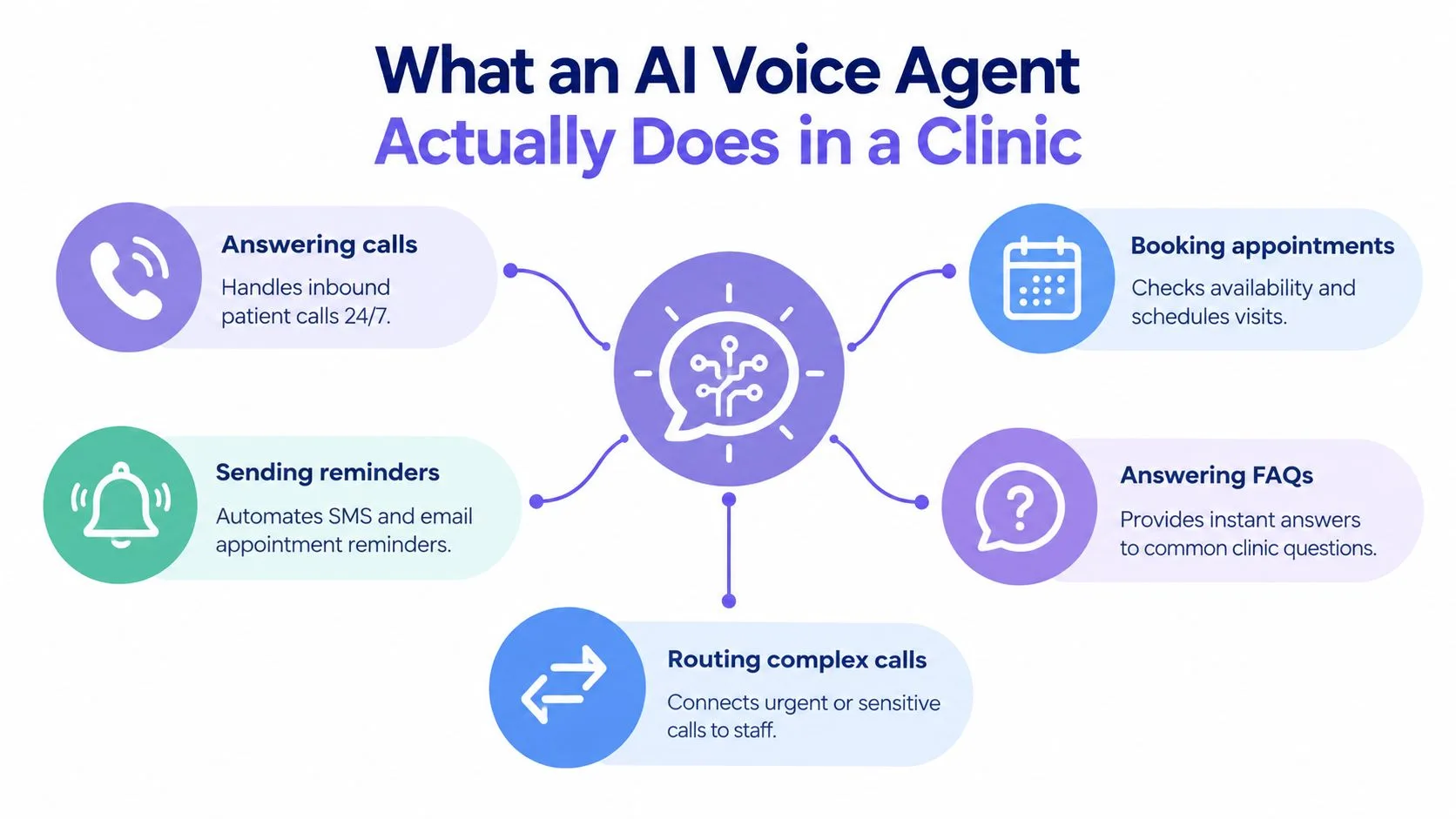
The five jobs it should do well
Keep the job list short. Answer overflow and after-hours calls. Identify the caller and the reason for calling. Book, reschedule or cancel against live availability. Answer fixed facts such as hours, address, fees policy wording you've approved, and what to bring. Route anything urgent, distressed, unclear or clinical to a person, fast and without argument.
Practical rule: If a task needs empathy under pressure, interpretation, or a clinical decision, it doesn't belong in the voice agent's self-service path.
Voice Agent Call Handling by Intent
| Call Intent | Voice Agent Handles | Escalates to Staff |
|---|---|---|
| New or changed appointment | Checks slots, books, confirms details | Complex family bookings, unclear identity |
| Opening hours, location, parking | Gives approved practice information | Complaints or billing disputes |
| Repeat script or results request | Takes a message for clinical review | Any discussion of medication or results |
| Symptoms, deterioration, distress | Gives emergency direction and transfers | Every case, immediately |
| Document status enquiry | Confirms receipt where PMS data allows | Missing, urgent or sensitive documents |
That table is the product. Vendors will try to sell you breadth. Buy accuracy within a boundary instead. A voice agent that books cleanly, spells Australian names back for confirmation, and knows when to stop will earn staff trust. One that tries to be helpful about chest pain will lose it on day one.
Why Australian Clinics Are Adopting Voice Agents Now
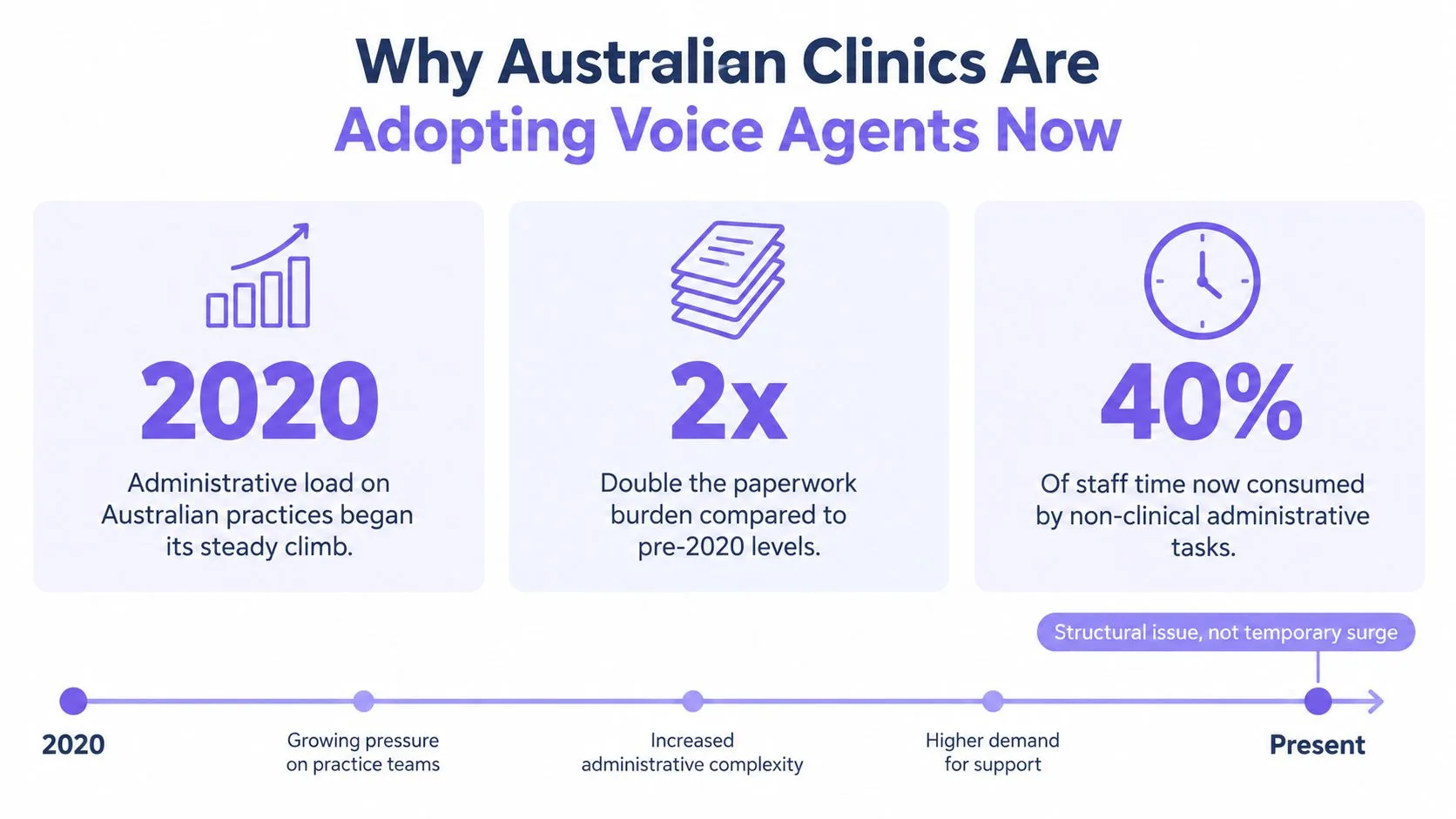
This isn't a novelty purchase. It's a capacity response. In the 2024 Deloitte survey of Australian healthcare workers, more than three-quarters of respondents believed their workload had increased since March 2020, frontline clinicians were struggling with administrative burdens, and most respondents wanted those duties delegated, reallocated or avoided so they could spend more time on higher-value work.
Read that carefully. It doesn't prove voice agents work. It quantifies the pressure that makes a clinic look at one. Phone administration is the obvious first target because it's repetitive, time-sensitive and mostly non-clinical. The same questions arrive every day, and a missed answer becomes a missed appointment, a repeat call, or a patient who books elsewhere.
The visual below frames that rising administrative load as a structural problem, not a bad week.
What the agent can absorb today
- Peak overflow: Morning surges, lunch cover and the post-weekend backlog, when callers abandon rather than wait.
- After-hours routine demand: Booking and rescheduling outside business hours, with clear messaging about what happens next.
- Repeat enquiries: Hours, location, new patient forms, and appointment preparation you've already documented.
- Confirmation work: Reading back name, date of birth, practitioner, date and time before anything is written to the diary.
What it must never absorb is clinical workload just because clinicians are busy. That's the trap. Workforce pressure justifies automating administration. It doesn't justify letting software reassure, interpret or prioritise symptoms.
Australian patients also aren't starting from trust, as the approval figures in the opening show. So your pitch to patients can't be innovation. It has to be clarity. You're using automation to answer faster, you're telling them upfront, and a person is available. If you're mapping the wider case for AI across healthcare operations, start with that limited promise and prove it on the phone line first.
For a plain walkthrough of how voice automation handles a routine booking conversation, watch the short demonstration below before you brief any vendor.
My recommendation is direct. Deploy an AI Voice Agent in Australia to protect reception capacity, not to cut reception headcount on a spreadsheet. Practices that frame it as staff replacement usually underinvest in escalation design, then blame the technology when patients push back.
Privacy, Consent and Disclosure Before the First Call
Don't switch the agent on and fix privacy later. In a clinic, a phone call can become health information in one sentence. A caller books for a skin check, then describes the lesion, mentions a medication, and asks whether it sounds serious. Your neat booking transcript now holds sensitive content, and your controls need to have anticipated that.
The OAIC guide to health privacy says health information should generally be collected directly from the patient, by lawful and fair means, and only when reasonably necessary for the organisation's activities. It also warns that recording a telephone consultation without informing the patient can breach the Telecommunications (Interception) Act 1979 and applicable state or territory listening-devices laws.
Configure these controls before go-live
- Open with disclosure: Say plainly that the caller is speaking with an AI assistant, state whether the call is recorded or transcribed, and explain why. Burying this in a website policy isn't disclosure.
- Offer an alternative where feasible: Give callers a clear path to a person or a non-recorded option. Some patients will decline AI. Let them, without a retention script.
- Collect the minimum: Name, contact number, date of birth for identity matching, practitioner and preferred time. You don't need a symptom narrative to book a standard appointment.
- Log consent events: Store the disclosure played, the caller's response, and the call identifier together. If a patient disputes what they were told, you need evidence, not recollection.
- Restrict access: Apply role-based access to audio and transcripts. Your marketing contractor doesn't need call recordings. Neither does every staff login.
- Set retention and deletion rules: Decide how long audio, transcripts and extracted booking data are kept, then automate deletion. Indefinite retention because storage is cheap is a liability.
- Support access and correction: Patients may seek access to recordings where applicable, so you need search, export and correction workflows that staff can operate.
Australian hosting alone doesn't make you compliant. Governance, vendor and subcontractor access, purpose of processing, and what flows into your PMS matter just as much as server location.
That point deserves emphasis because vendors lean hard on hosting. Ask who can access production audio for troubleshooting, which subprocessors touch transcription, whether data is used to train models, and how deletion propagates to backups. Put the answers in your vendor paperwork. If you need a model for how processing terms, subprocessors and security duties are documented, reviewing our data processing policy from RecensioAI B.V. is a useful benchmark for the questions to put to any voice vendor.
Also map the layered obligations properly. The federal Privacy Act, health information protections, My Health Records requirements and potentially state-based privacy laws can all be in play. The Department of Health guidance on AI in health care warns that improperly protected AI data can cause privacy breaches or patient harm. Treat that as an operational brief. Define the purpose narrowly, keep sensitive free text out of non-clinical systems, and route clinical content to trained staff instead of copying it wherever the software finds convenient.
Connecting the Voice Agent to Practice Management Software
A voice agent that can't write to your PMS is an expensive answering service. Staff will retype bookings, miss details, and stop trusting it within a week. The value sits at the integration boundary, where a confirmed conversation becomes a correct diary entry in Best Practice, MedicalDirector or your other PMS with API connectivity.
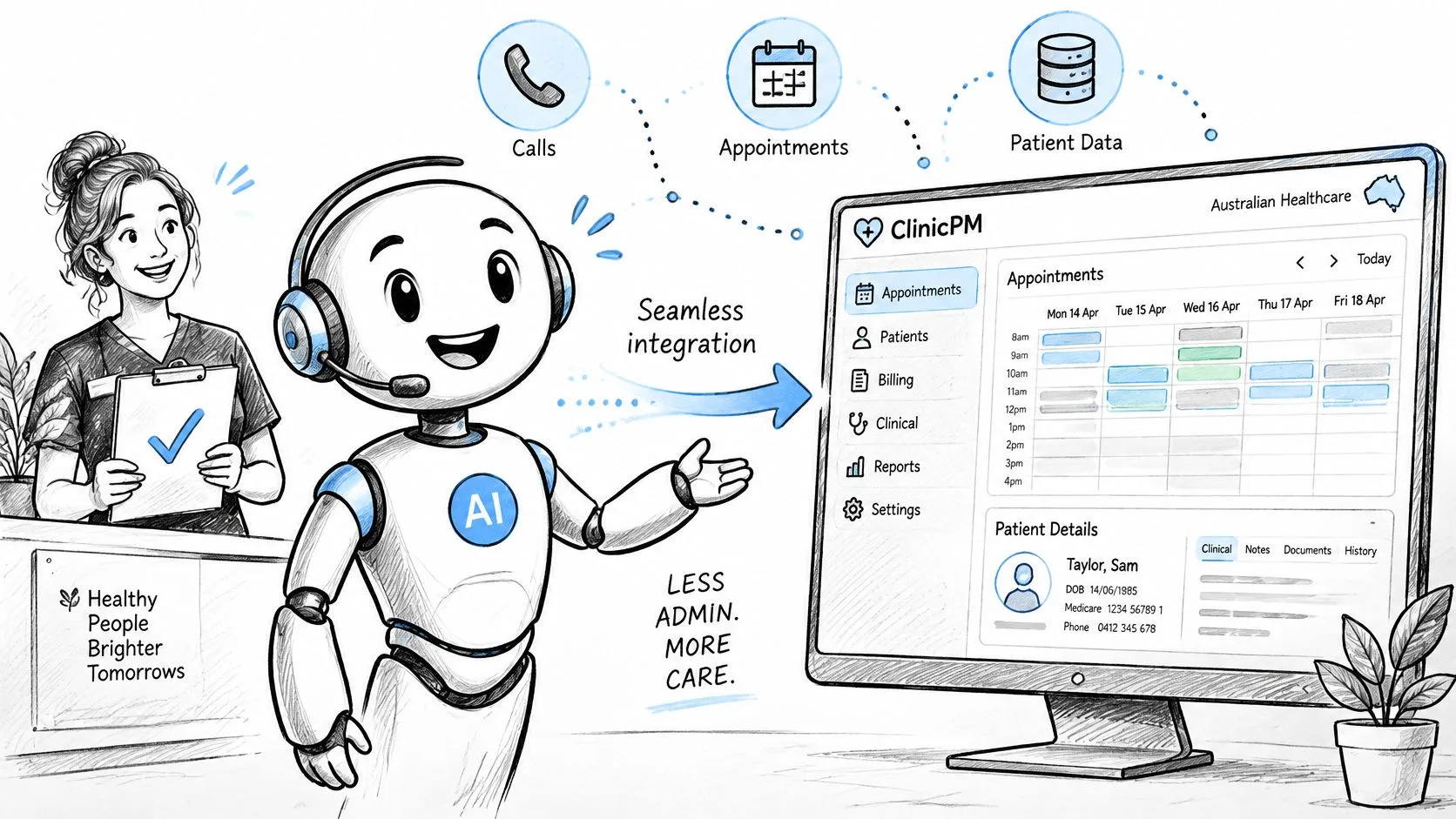
What should write back automatically
Only data the caller has confirmed and the system has validated. That means patient identity matched to an existing record, practitioner, appointment type where your practice allows self-selection, date, time and duration from live slot availability. The agent should read the booking back, get a clear yes, then write it once. Cancellation and rescheduling follow the same pattern. Find the existing appointment, confirm identity, confirm the change, then update the diary and trigger your normal confirmation message.
New patients need tighter rules. Create a provisional record only if your PMS workflow supports duplicate checking and staff review. Australian practices already fight duplicate files. Don't let a misheard surname manufacture more of them.
What should never write back automatically
- Symptom descriptions: Route to a controlled review queue for staff, not into the clinical notes as raw transcript.
- Medication and prescribing requests: Log as a task for the clinical team. The agent doesn't summarise dosage changes into the record.
- Uncertain identity matches: Queue for human verification. A similar name and date of birth isn't a match.
- Free-text triage input: Keep it out of non-clinical systems and don't let it auto-populate recall or marketing lists.
Every write needs an audit trail. Who called, what was confirmed, what the PMS returned, and whether a human later edited it. When a patient says they booked Tuesday and the diary says Thursday, you need that trail to resolve it in minutes.
Integration also means respecting how clinical systems exchange data, field by field, rather than dumping transcripts across. If your IT provider is new to this, a primer on how EHR systems talk to each other from FaxZen helps frame why structured, confirmed fields beat free-text transfer. And if you're still comparing platforms, review your shortlist against practice software that supports clean Australian PMS integration before you sign a voice contract.
Test the failure paths, not just the happy path. Full diary. Doctor running in emergency session. Caller changes their mind mid-booking. PMS timeout after the caller heard a confirmation. Decide now whether the agent retries, queues or transfers, because patients will find every gap you leave.
Where the Voice Agent Must Stop
Most vendors sell what the agent can do. I judge them on what it refuses to do. The assumption that a more capable agent is a better agent is wrong in a clinic. Capability without a hard boundary creates clinical risk that fluent speech disguises.
Ahpra's information for practitioners who provide virtual care requires practitioners to understand how a technology platform captures and stores personal information, protect privacy and confidentiality, explain the technology's use, and obtain informed consent when supporting tools such as AI are used. It also says patients should understand when they're not consulting a registered health practitioner, and practitioners must recognise when telehealth is unsuitable. Apply that logic to your phone line.
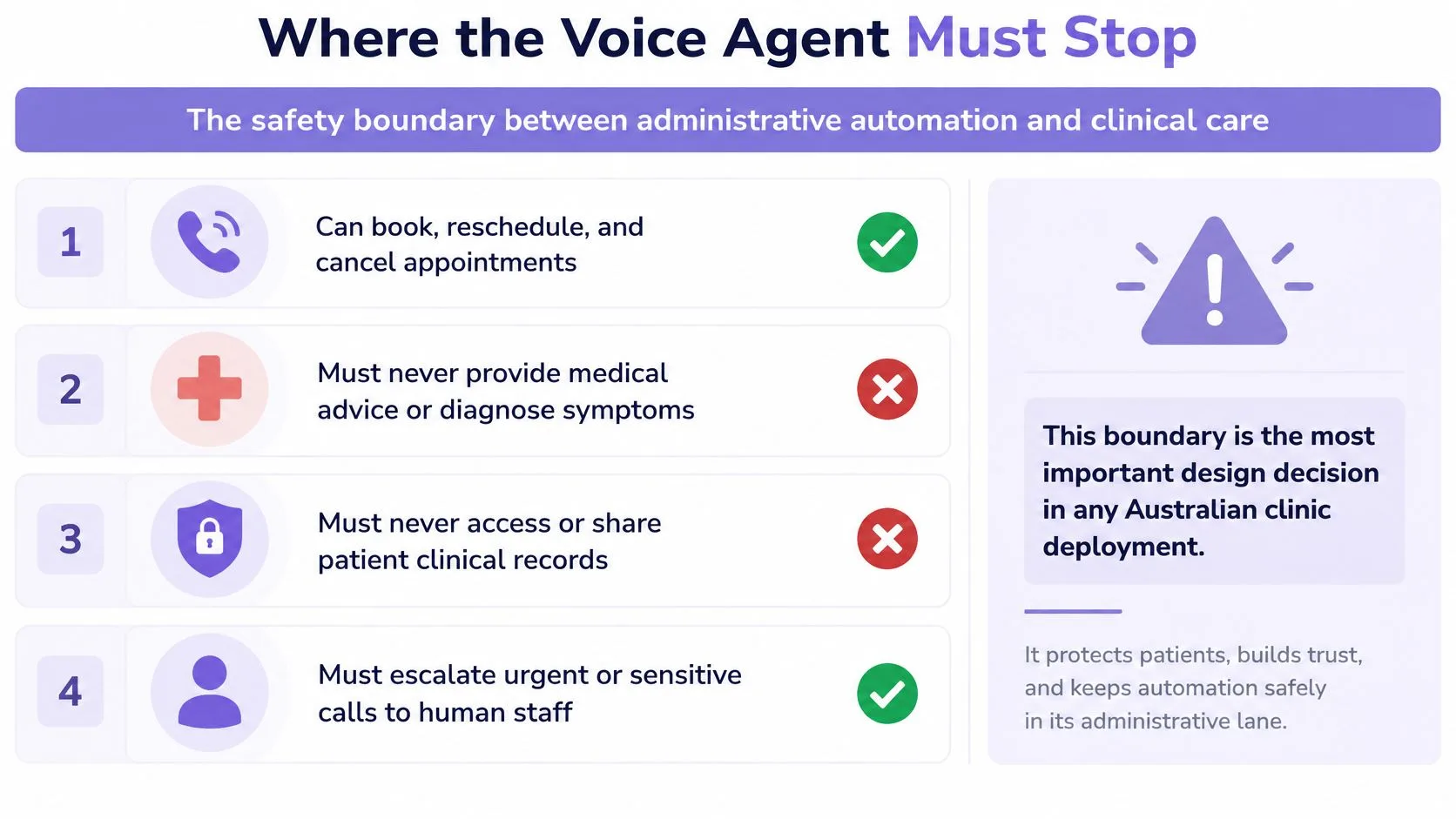
Self-service on one side of the line
Booking, cancellation, opening hours, location, parking, routine document status and appointment preparation from approved wording. These are administrative facts. The agent can complete them, confirm them, and log them.
Immediate escalation on the other side
Diagnosis questions, urgent symptoms, prescribing, test interpretation, medication advice, deterioration, mental health crisis, and any caller asking whether they should go to emergency. The response is not a smarter script. It's emergency-direction messaging where appropriate and immediate human handoff, with the minimum routing information captured and a full record of the transfer.
Ambiguity gets the same treatment. A distressed caller, a parent describing a sick child, someone with language barriers, a minor calling alone, or a request that doesn't fit booking scope should not be coaxed through more questions so the software can classify them neatly. Escalate early. Your escalation rate rising in week one is not failure. It usually means the boundary is working.
Never let the agent say anything that a reasonable patient could hear as reassurance, assessment or advice about their condition.
Build this with intent classification plus deterministic escalation rules, not vibes. Certain words, intents and caller states trigger transfer regardless of model confidence. Test them with your nurses and senior receptionists using ugly, real scenarios. The caller who says it's probably nothing. The caller who minimises. The caller who asks the agent directly, do you think this can wait until Friday. The correct answer every time is a person.
Accountability stays with the practice. The Department of Health departmental AI scribe disclosure reflects the position that AI outputs can affect patient safety and clinicians remain accountable for the accuracy of AI-generated material, with data quality and ongoing assurance required. Your voice agent is no different. Sample calls, audit hand-offs, and fix scripts when you hear drift.
How TOOLii Fits an Australian Clinic Workflow
Judge a voice agent by a full day, not a demo call. Here's how the pieces sit together in a practice running one integrated stack, compared with buying a standalone phone widget and stitching the rest yourself.
At 7.30am, before doors open, Voicebot takes early calls and overflow. It books against the diary through iAppointment Book, so confirmed slots land in the PMS rather than in a staff inbox. Reception arrives to patients at the desk, not a voicemail backlog. Anything clinical from overnight sits in a review queue for staff, because that's where it belongs.
Mid-morning, iRecall works through preventative-care follow-ups for patients due for review, while reception handles the exceptions instead of dialling every routine recall by hand. In consult rooms, Doctor Consult supports structured consultation notes, which matters because the booking is only the front end of the visit. On the website, TChatbot answers routine enquiries that never needed a phone call, using the same approved practice information.
Later, Syncomatic sends appointment reminders by SMS and email, closing the loop the voice agent opened. File Transfer moves clinical documents securely between practices instead of through ad hoc email threads. Document handling follows the same principle throughout. Confirm the structured data, route the uncertain content to a person. Teams designing that split can learn from approaches to designing AI agents for document processing from Matil, where extraction, validation and human review are separate steps rather than one hopeful automation.
The contrast with a standalone voice tool is stark. A widget can answer and sound impressive. It can't confirm into your PMS, trigger recalls, support the consult note, and send the reminder without integration work landing on your staff. You're not buying a voice. You're buying whether the work finishes.
That restraint also fits local sentiment. The Australian Parliament's 2024 report on adopting artificial intelligence reported that only 27% to 43% of Australians approved of AI use in healthcare, compared with 60% who supported AI development more broadly. A stack that keeps AI on administration, discloses it, and keeps clinicians visibly in charge is built for that trust gap. One that markets autonomous patient interaction is not.
A Deployment Readiness Checklist for Practice Managers
Everything above collapses into decisions you make before go-live, plus habits you keep after it. Use this as your sign-off list. If an item has no owner and no date, you're not ready.
Before the first live call
- Disclosure script approved: The opening lines name the AI, state recording or transcription, explain purpose, and offer a human path. Your practice principal has read them aloud and approved the wording.
- Escalation rules documented: Clinical intents, distress, ambiguity, minors, language difficulty and out-of-scope requests transfer immediately. After-hours routing and emergency messaging are tested, not assumed.
- PMS write-back scope fixed: Confirmed bookings write automatically. Symptom text, medication requests and uncertain identity matches queue for review. Duplicate-record handling is agreed with staff.
- Privacy settings configured: Role-based access, retention windows, automated deletion, audit logging and patient access workflows are switched on and tested.
- Data map signed off: You can state where audio and transcripts are processed, which subprocessors are involved, and whether data trains models. In writing, from the vendor.
- Reminder flow connected: Confirmations and reminders fire from the PMS event, and your team has checked the wording against your automated appointment reminder setup so patients get one clear message, not two conflicting ones.
During the first fortnight
Start narrow. Overflow and after-hours only, or one practitioner diary, while your team listens daily. Train staff on hand-off scripts so a transferred caller hears a warm continuation, not an apology for the robot. Give reception a simple defect log. Misheard name, wrong appointment type, escalation that should have happened sooner. Review it with the vendor weekly and demand script or rule changes, not reassurance.
Owner rule: Name one human owner for the voice agent. If everyone owns it, nobody audits it.
Every month after go-live
Measure what protects patients and the diary. Track abandoned-call rate to see whether access improved. Track booking accuracy by sampling completed appointments against recordings. Watch escalation rate and read a sample of escalations to confirm they happened early enough. Monitor repeat-call rate, because a patient who calls back to check the agent booked correctly is telling you trust isn't there yet. Audit specifically for inappropriate reassurance. One instance is a script defect to fix that week, not a statistic to average away.
Also review access logs, deletion jobs and any vendor changes to subprocessors or models. A model update can change how your agent phrases things. Treat significant changes like a clinical software update. Test in a controlled window, listen to calls, then approve.
Hold the accountability line internally. The practice, not the vendor, answers to the patient who was misbooked, misheard or kept from a human too long. Your contract should give you audit rights, data export, deletion on exit and prompt incident notification, but no contract transfers your professional obligations. Staff need to hear that from you, because they'll either trust the system blindly or work around it. Both responses cause incidents.
Do this properly and the result is unglamorous, which is the point. Fewer ringing-out phones. Cleaner diaries. Receptionists spending their attention on the patient in front of them and the caller who needs a person. That's what a well-bounded AI Voice Agent in Australia buys you. Anything promising more than that is selling you risk dressed as capability.
If you're ready to put that boundary into practice, TOOLii offers Voicebot and iAppointment Book built for Australian PMS environments, handling bookings, reschedules and routine enquiries while routing clinical calls to your team. Visit the site to see how the voice workflow connects with recalls, reminders and document handling in one practice-wide stack, then book a conversation about a controlled rollout for your clinic.