
A patient leaves the consulting room, the next appointment is already waiting, and the note says something like “reviewed, stable, continue meds”. The GP remembers the conversation, but the nurse covering recalls, the practice manager checking follow-up work, and the specialist receiving a referral may not have enough context to act safely.
A structured note changes that handover. It gives people a predictable way to find the patient's concerns, observations, clinical reasoning, actions and review plan. It also gives practice systems a better chance of finding allergies, medicines, diagnoses and recall dates without asking someone to interpret a paragraph by hand.
The useful question isn't which format looks neatest. It's which types of structured notes remain readable for clinicians while also producing reliable data for Best Practice workflows, recalls, My Health Record exchange and later analysis.
Table of Contents
- Why Messy Notes Slow Down Australian Clinics
- What Counts as a Structured Clinical Note
- Common Types of Structured Notes Explained
- Coded Fields and Discrete Data Behind the Narrative
- How GP and Specialist Clinics Use Each Note Type
- Benefits for Workflows and PMS Interoperability
- Choosing and Implementing Structured Notes Safely
Why Messy Notes Slow Down Australian Clinics
At 4.45 pm, a patient calls about a medicine change discussed during the morning clinic. The GP remembers reducing the dose, but the progress note contains several sentences of free text, with the medication instruction buried near the end. The nurse has to search the encounter, read the whole entry and confirm whether the plan was completed or merely discussed.
A different patient needs a follow-up recall. The relevant instruction appears as “review in a few weeks” without a discrete date, recall reason or responsible clinician. The practice can still act, but only by relying on memory, manual review or a separate task list. That creates work that a well-designed note could have prevented.
The same note serves several readers
A clinical note has at least two audiences. The first is human: the next GP, nurse, allied health professional or specialist needs enough narrative to understand what happened and why. The second is operational: the practice-management system needs identifiable fields for medicines, allergies, diagnoses, observations, care plans and follow-up.
A paragraph may be clear to the author while remaining difficult for software to retrieve. Conversely, a form filled with isolated fields may be easy to search but fail to capture the reasoning behind a complex assessment. Australian guidance supports documentation that is complete, accurate, timely, objective and accessible, while the RACGP guidance on quality health records emphasises records that allow another practitioner to continue care.
Practical rule: If a colleague must read the entire note to find one medicine, one risk or one follow-up action, that information probably needs its own field.
Structured documentation also supports safer information governance. Clinics reviewing access, retention, audit trails and automated processing can use resources on healthtech policy enforcement alongside their clinical-record procedures. The aim isn't to turn every consultation into a rigid form. It's to make the important facts visible, attributable and usable.
The decision for a clinic is therefore broader than choosing SOAP or narrative notes. Teams need to decide which headings clinicians will use, which values must be discrete, how coded concepts are confirmed, and how an AI-generated draft becomes a reviewed clinical record.
What Counts as a Structured Clinical Note
Think of a messy note as a pile of loose papers. The information may be present, but finding the allergy, latest observation or agreed review plan depends on reading and remembering. A structured note is closer to a labelled filing cabinet. Each drawer has a purpose, each document follows a known arrangement, and important items can be retrieved without examining every page.
Build the note in layers
The first layer is consistent headings. Subjective history, objective findings, assessment and plan give the reader a familiar route through the consultation. A heading is useful only when the practice applies it consistently. “Plan” should not mean medicine instructions in one template and general comments in another.
The second layer is discrete data. An allergy, medicine, dose, observation, diagnosis or review date should be stored in a field that a person and a system can identify separately. The surrounding narrative still matters, especially when the clinician explains uncertainty or competing considerations, but the key operational value shouldn't be hidden inside prose.
The third layer is standardised terminology. Australian health-data guidance identifies SNOMED CT-AU as an important basis for structured data capture in electronic medical records, including use with FHIR standards. A diagnosis represented by a recognised clinical concept is more reusable than a free-text phrase that varies between clinicians.
The fourth layer is provenance. A reliable record shows who entered the information, when it was entered, which encounter it belongs to and whether the value was suggested or confirmed. Queensland Health guidance advises that entries be made as soon as possible after an intervention, remain concise and accurate, and appear in chronological date-and-time order. That sequence matters when several clinicians contribute to ongoing care.

Readability and machine-readability are different
A note can be well organised for a clinician and still be poor for exchange. A heading such as “medications” improves scanning, but a medication name, dose and repeats stored as separate fields are more useful for reconciliation and downstream workflows.
The reverse is also possible. A template can force every answer into a field while leaving no place for clinical context. The practical target is a hybrid note: a predictable human-readable structure, supported by discrete values, coded concepts, timestamps and an audit history.
A simple test helps. Ask whether another practitioner can understand the encounter quickly, then ask whether the system can find the diagnosis, medicine, allergy and follow-up action without interpreting the whole paragraph. A note that passes both tests is structured for care, not merely formatted for appearance.
Common Types of Structured Notes Explained
Different note families solve different clinical problems. SOAP is often a dependable starting point for a general consultation because it separates what the patient reports from what the clinician observes, concludes and plans.
SOAP contains:
- Subjective: symptoms, concerns and relevant history supplied by the patient.
- Objective: examination findings, measurements and investigation results.
- Assessment: the clinician's interpretation, including working diagnoses.
- Plan: treatment, investigations, education, referrals and review.
A patient with a new headache might have “headache for three days” under Subjective, blood pressure and neurological findings under Objective, the working assessment under Assessment, and investigation or safety-netting instructions under Plan.
Queensland Health identifies SOAP as an adopted format in several Hospital and Health Services and describes extensions including intervention, evaluation and recommendations or revisions. SOAPIER adds those elements when the record needs to show what was done, how the patient responded and what changed. It suits wound care, medication administration, rehabilitation or any encounter where treatment response is clinically important.
Chronological progress notes are less about fixed headings and more about preserving the order of events. They work well for inpatient-style follow-up, repeated observations, multi-step treatment and ongoing care where timing itself explains the clinical story.
Problem-oriented notes organise the encounter around separate issues. A patient may have one problem for diabetes management, another for knee pain and another for preventive care. Each problem can carry its own assessment, actions and review status. This improves retrieval when a clinician wants to follow one condition across visits.
Templated checklists suit predictable examinations, procedures and safety checks. They reduce omission risk when the same elements must be considered repeatedly, but they should leave room for abnormal findings and reasoning rather than encouraging automatic completion.
SOAP answers, “What did the patient report, what did I find, what do I think, and what will I do?” SOAPIER answers those questions and preserves the intervention and response.

DAP, made up of Data, Assessment and Plan, can be useful for shorter follow-ups when a separate Subjective and Objective split adds little value. SBAR, meaning Situation, Background, Assessment and Recommendation, is better understood as a communication structure for handover than as a universal consultation record. The right choice depends on the encounter, the information another person must retrieve and the fields the practice needs to exchange.
For clinics converting spoken consultations into structured drafts, medical transcription notes should be reviewed against the chosen template rather than accepted as an undifferentiated transcript.
Coded Fields and Discrete Data Behind the Narrative
A detailed paragraph can still fail a recall workflow. “Discussed screening and will arrange follow-up” gives a reader some context, but it doesn't reliably identify the screening item, responsible person, due date or recall status. Discrete data turns those facts into separate, retrievable elements.
Australian health-data guidance describes SNOMED CT-AU as a recognised clinical terminology used for structured capture in general practice and hospitals. In plain language, terminology gives a concept a consistent label that can be exchanged and compared, even when clinicians use different wording in conversation.
FHIR provides a way to represent and exchange health information through defined resources and fields. HL7 Clinical Document Architecture provides a structured header and body for electronic clinical documents. These standards don't remove the need for good clinical writing. They give the narrative and data a shared container so another system can interpret more of the record consistently.
What belongs in a field
A practice should decide which information needs to remain discrete before building templates. Common candidates include:
- Identity and provenance: author, encounter type, date and time.
- Clinical concepts: confirmed diagnosis, allergies, observations and procedures.
- Medicines: product, dose, route, frequency, repeats and status.
- Care actions: referral, investigation, treatment, education and review date.
- Decision status: clinician-confirmed value, suggested value, corrected value or unresolved item.
RACGP guidance supports recognised clinical terminology and consistent coding because coded entries improve continuity and enable analysis of care and outcomes. A system should distinguish a clinician-confirmed diagnosis from an AI suggestion. It should retain version history rather than replace one value with another without notice.
Narrative versus coded note elements
| Note Element | Best Format | Why It Matters |
|---|---|---|
| Patient concern and symptom story | Narrative under a consistent heading | Preserves context, chronology and the patient's own account |
| Diagnosis | Coded field plus narrative reasoning | Supports search and comparison without losing uncertainty or explanation |
| Allergy | Discrete field with status and provenance | Makes safety information easier to retrieve |
| Medicine | Discrete medication fields plus instructions in narrative | Supports reconciliation while retaining practical directions |
| Examination finding | Discrete observation where appropriate, with explanatory text | Enables comparison and gives meaning to abnormal results |
| Follow-up | Discrete action and date, with narrative details | Supports recalls, task assignment and continuity |
| Clinical reasoning | Narrative | Captures nuance that a dropdown cannot represent |
| Consent | Discrete record with relevant context | Shows what was discussed and how the decision was recorded |
The useful design is not “all coded” or “all narrative”. It's a layered record in which humans can understand the consultation and systems can retrieve the facts that drive care, reporting and exchange.
Data governance becomes particularly important when these fields move between a practice-management system, a clinical document and an external service. Teams assessing ownership, access, retention and correction processes may also consult guidance on MedQAIR data management governance as part of a broader governance review.
How GP and Specialist Clinics Use Each Note Type
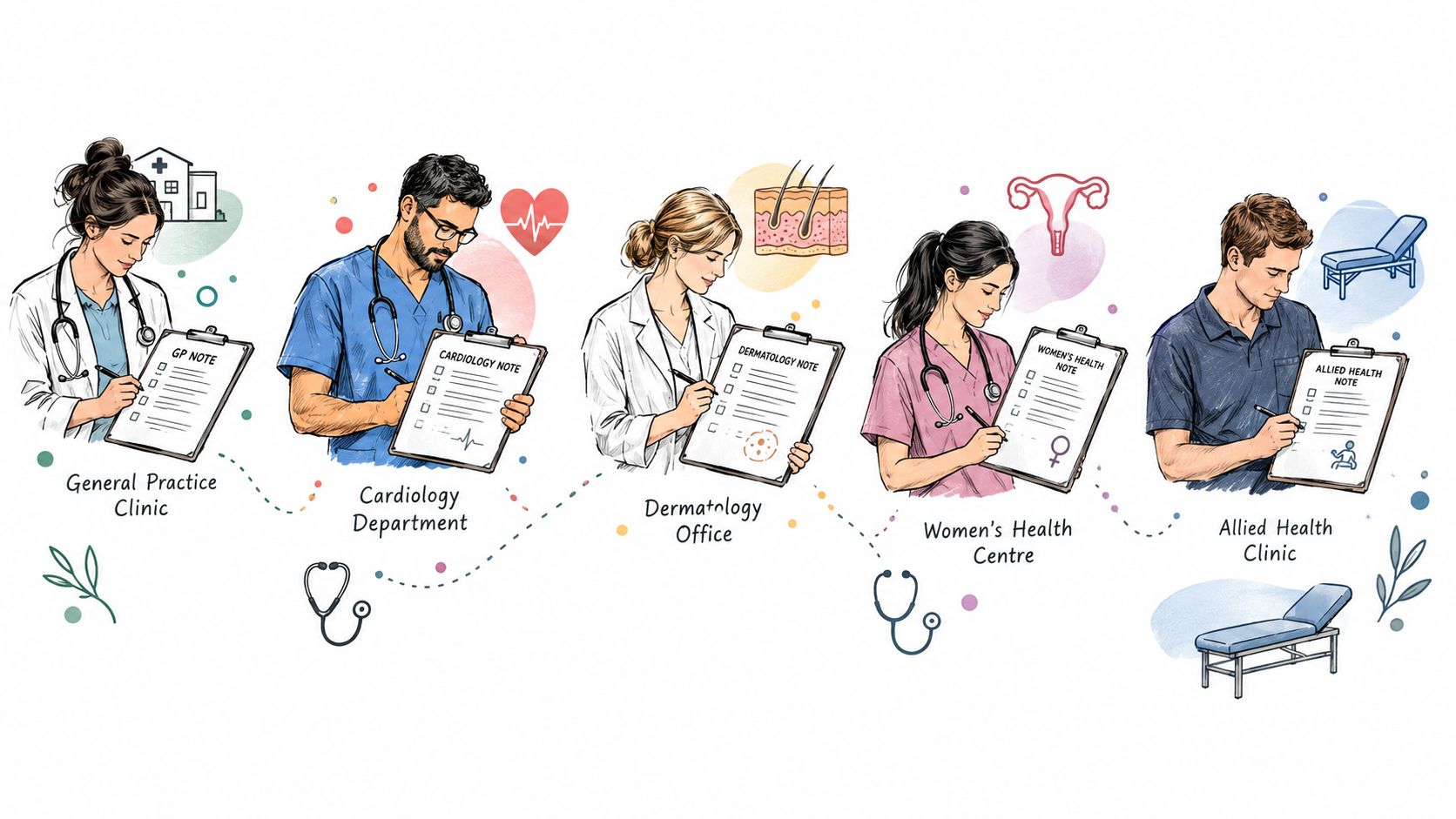
A suburban general practice often starts with a routine consultation. The GP records the patient's concern, relevant history, examination, assessment and plan in a SOAP-style note. If the patient needs a blood test, medication review or preventive-care follow-up, those actions should also appear as discrete tasks or recall information rather than remaining only in the closing paragraph.
The same patient may return for a care-plan review. A problem-oriented structure makes it easier to compare what was agreed for each condition, which action was completed and what remains outstanding. A care plan should remain readable to the patient's care team, while key actions and dates need a form that the practice can track.
Specialist work changes the emphasis
A cardiology clinic may rely on structured observation fields for symptoms, examination, investigations and medication changes, with narrative reasoning around risk and treatment choices. A dermatology clinic may use a templated checklist for lesion location, appearance and procedure details, then add free text for an unusual presentation or differential diagnosis.
Women's health consultations often combine sensitive history, examination, consent and follow-up. A rigid template can support completeness, but the clinician must be able to record patient preferences and context without forcing them into misleading categories.
Allied health providers may favour DAP-style follow-up notes or problem-oriented progress notes. The data section can capture functional status and reported change, the assessment can explain professional interpretation, and the plan can identify exercises, education, referrals or review arrangements.
Referrals and discharge records need a different lens
A referral note isn't just a longer consultation note. The receiving clinician needs the reason for referral, relevant history, examination and investigation findings, current medicines, allergies, questions to answer and urgency. A discharge summary needs the admission context, significant findings, treatment, medication changes, follow-up and information the next provider must act on.
A structured handover can use SBAR when the immediate purpose is communication. The full clinical record can retain a richer consultation or progress note, while the handover presents the facts needed for the next decision.
For a practical example of how referral information can be organised, clinics can review this referral letter sample and adapt the fields to their specialty, recipient and practice-management workflow.
The format should follow the patient journey. Consultation notes explain an encounter, care plans coordinate ongoing work, referral notes transfer a clinical question, discharge summaries close one episode and progress notes preserve change over time.
Benefits for Workflows and PMS Interoperability
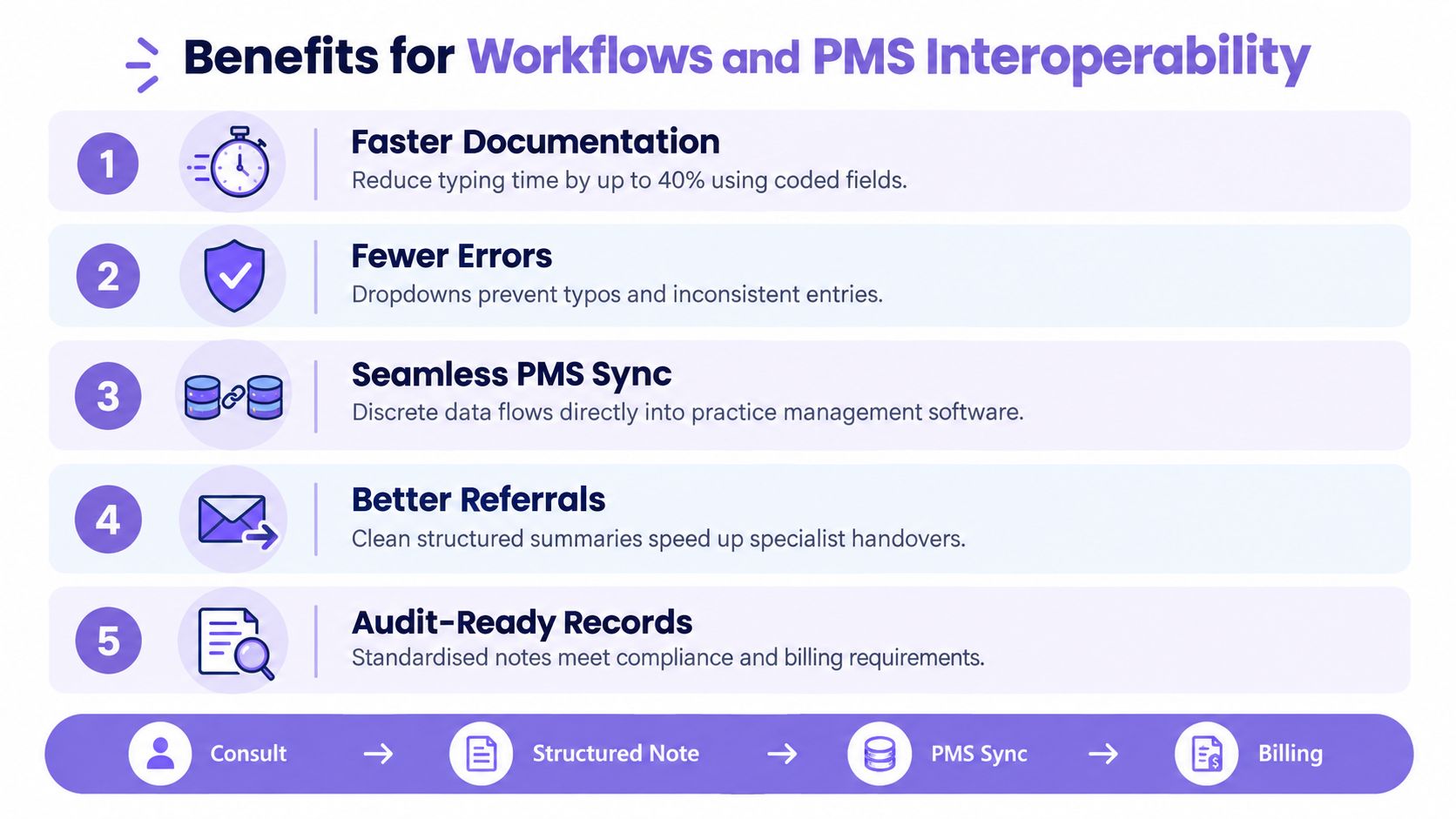
The strongest design combines narrative context with coded, discrete data. Clinicians shouldn't have to choose between a note that reads naturally and a record that a practice-management system can use. The template should handle predictable facts in fields and reserve prose for reasoning, nuance and exceptions.
This approach supports several practical workflows. A nurse can find an allergy without scanning every paragraph. A practice manager can identify follow-up work by status and date. A GP can compare care-plan actions across visits. A receiving clinician can read the story without decoding a collection of isolated dropdown values.
A practical field decision
Before implementing a template, ask five questions:
- Can the practice search for it? If the answer is no, consider a discrete field.
- Does it affect immediate safety? Allergies, medication instructions and important observations shouldn't rely only on prose.
- Will another system need it? Diagnoses, medicines, care actions and follow-up dates often need defined fields for exchange.
- Does the value require reasoning? Keep the explanation in narrative and link it to the relevant coded concept.
- Could the value change? Use author, timestamp, status and version history so corrections remain visible.
These choices reduce double entry and make handover more dependable, but they don't guarantee safe interoperability by themselves. The clinic still needs validated mappings, clear ownership and a process for resolving values that don't match the receiving system.
Design for the destination
Best Practice, other practice-management systems and national exchange pathways may expect different document structures and terminology handling. HL7 CDA and FHIR are part of Australia's interoperability environment, but a clinic should confirm what its specific system accepts, how fields map and whether an imported value remains identifiable as confirmed clinical data.
A useful implementation test follows one consultation from start to finish. Can the clinician document it quickly? Can another clinician understand it? Can the system retrieve the medicine and follow-up action? Can the practice correct an error while preserving provenance? Can the exported document retain enough context for the recipient?
Teams assessing electronic medical records software should apply those questions to the complete workflow, not just the note editor. Integration succeeds when the structured record moves cleanly through documentation, review, recalls, reporting and handover.
Good structure also helps external reviewers understand how information was created and transformed. For organisations dealing with sensitive records across professional boundaries, background on EHR data mapping for law firms can provide a useful perspective on mapping, provenance and controlled exchange, even though clinical workflows require their own governance decisions.
Choosing and Implementing Structured Notes Safely
Start with the encounter, not the software. Choose SOAP for routine consultations, SOAPIER when intervention and response need to be visible, chronological progress notes for ongoing events, and problem-oriented structures when separate conditions require separate tracking. Then identify the mandatory fields that support safe care and the discrete fields required by the practice-management workflow.
Move from draft to signed record
An AI-assisted workflow should have clear stages:
- Consent and disclosure: Tell the patient when a digital scribe is being used and provide enough information for informed consent, including how information is kept private and disclosed.
- Draft creation: Treat the transcription or generated structure as a draft. Preserve the source encounter, author and timestamp.
- Clinical review: Check names, medicines, doses, allergies, diagnoses, negations, uncertainty and follow-up actions. Do not allow an inferred value to become a confirmed field without clinician confirmation.
- Correction and sign-off: Record amendments and identify the clinician who approves the final note.
- Retention and access: Apply the clinic's privacy, retention, access and deletion controls to both the generated material and the signed record.
The TGA states that a digital scribe used only to transcribe or translate a conversation is generally not a medical device. Software that analyses or interprets the conversation, such as generating a diagnosis, differential diagnosis or treatment recommendation not explicitly stated by the practitioner, can fall within medical-device regulation. Read the TGA guidance on digital scribes before enabling features that move beyond transcription.
Clinicians remain accountable for the accuracy of the record. A safe system makes uncertainty visible, separates suggestions from confirmed facts, supports review before upload and prevents a polished draft from being mistaken for a signed clinical document.
The best of the types of structured notes is therefore the one that fits the clinical purpose, supports fast human review and exposes the discrete information that later workflows need. Templates should guide clinicians, not replace judgement.
TOOLii's Doctor Consult workflow converts consultation audio into structured clinical notes for practitioner review and approval, with support for care plans, suggested diagnoses and patient insights. Visit TOOLii to see how structured documentation can fit into your clinic's existing clinical and practice-management workflows.