
By August 2021, healthcare providers in Australia had uploaded approximately 170 million clinical documents to My Health Record, and records containing data had grown by more than 1.87 million over the preceding year, according to the Australian Digital Health Agency's My Health Record statistics. Those figures put medical transcription in perspective: it's not just typing up a letter. It helps turn spoken clinical information into records that can be found, reviewed and shared.
Table of Contents
- Why Clinics Rely on a Medical Transcription Service
- Core Services Inside a Medical Transcription Service
- Outsourced and In-House Transcription Compared
- Pricing Models and What Drives Cost
- Service Level Agreements to Check Before Signing
- Compliance, Consent and Patient Identity Checks
- Choosing a Provider and Your Next Step
Why Clinics Rely on a Medical Transcription Service
Think of a clinic's records as a library. Each new book needs a clear title, an author and a place on the shelf before someone can find it. Dictated consultations, outpatient letters and referral correspondence need the same care: they must become readable, searchable information and be linked to the right patient record.
On a busy clinic day, a doctor might dictate notes between appointments, while an administrator receives a specialist letter and a referral arrives through another channel. Until those items are transcribed, checked and filed, they're like books left in a delivery box. The information exists, but the people who need it may not be able to locate or use it quickly.
A medical transcription service helps with that gap. Depending on the service, it may convert audio into text, format documents, organise key details and prepare records for review or filing. The important point is that transcription sits inside a larger information workflow. A document needs to be accurate, attached to the correct patient and available to the clinician who must act on it.
Australia's digital health environment makes that workflow increasingly important. The national document figures show the scale of information providers are handling, but they don't mean every clinic needs the same setup. A small practice with occasional letters may need a simple dictation process. A multi-site service handling varied reports may need stronger routing, review and integration controls.
For clinicians considering live capture rather than sending recordings for later typing, live transcription for doctor's appointments offers an example of how speech can be converted during a consultation. Whichever approach a clinic chooses, the practical test is the same: does the resulting record help the team find the right information, check it and use it safely?
Core Services Inside a Medical Transcription Service
A medical transcription service can do more than turn speech into a plain text file. Follow the document as it moves through the workflow, and the difference becomes clearer.

From capture to a reviewable draft
The process starts with a source: a clinician's dictation, a recorded consultation, or an incoming letter that needs to be transcribed or prepared for a system. The clinic should know what formats the provider accepts, how staff submit files, and what happens if the audio is unclear or incomplete.
Next comes transcription. Human transcriptionists, speech-recognition software or a combination of both can produce the draft. The method matters, but so does what follows. Medical terms can sound alike, and a transcript can read smoothly while still misrepresenting a medicine, symptom or instruction.
The draft should be available for review, not written over the original record without anyone noticing. That gives the clinician a chance to compare the text with the source and correct anything that could affect care.
From text to a usable clinical record
After transcription, the service may format the content and organise details such as diagnoses, medications and follow-up actions. This isn't automatically the same as assigning clinical codes. Practices that need to understand how coding fits into administrative and revenue workflows can consult Clarity's coding guidance for revenue cycle leaders.
Then comes the handover into the practice workflow. The document needs to be associated with the correct patient, retain its author or provider attribution, and remain clearly marked as a draft until reviewed and signed through the clinic's process. Think of it as a relay race: if one handover loses the patient identity or the document's status, the whole workflow can stumble.
Clinics should also decide whether they need narrative text, structured fields, or both. This guide to structured clinical notes can help teams think through how organised note formats differ from a block of prose.
Before comparing providers, check whether the service supports audio capture, transcription, formatting, review, patient matching, secure transfer and the filing workflow your clinic uses. A text file is an output. A clinical transcription workflow is the whole relay.
Outsourced and In-House Transcription Compared
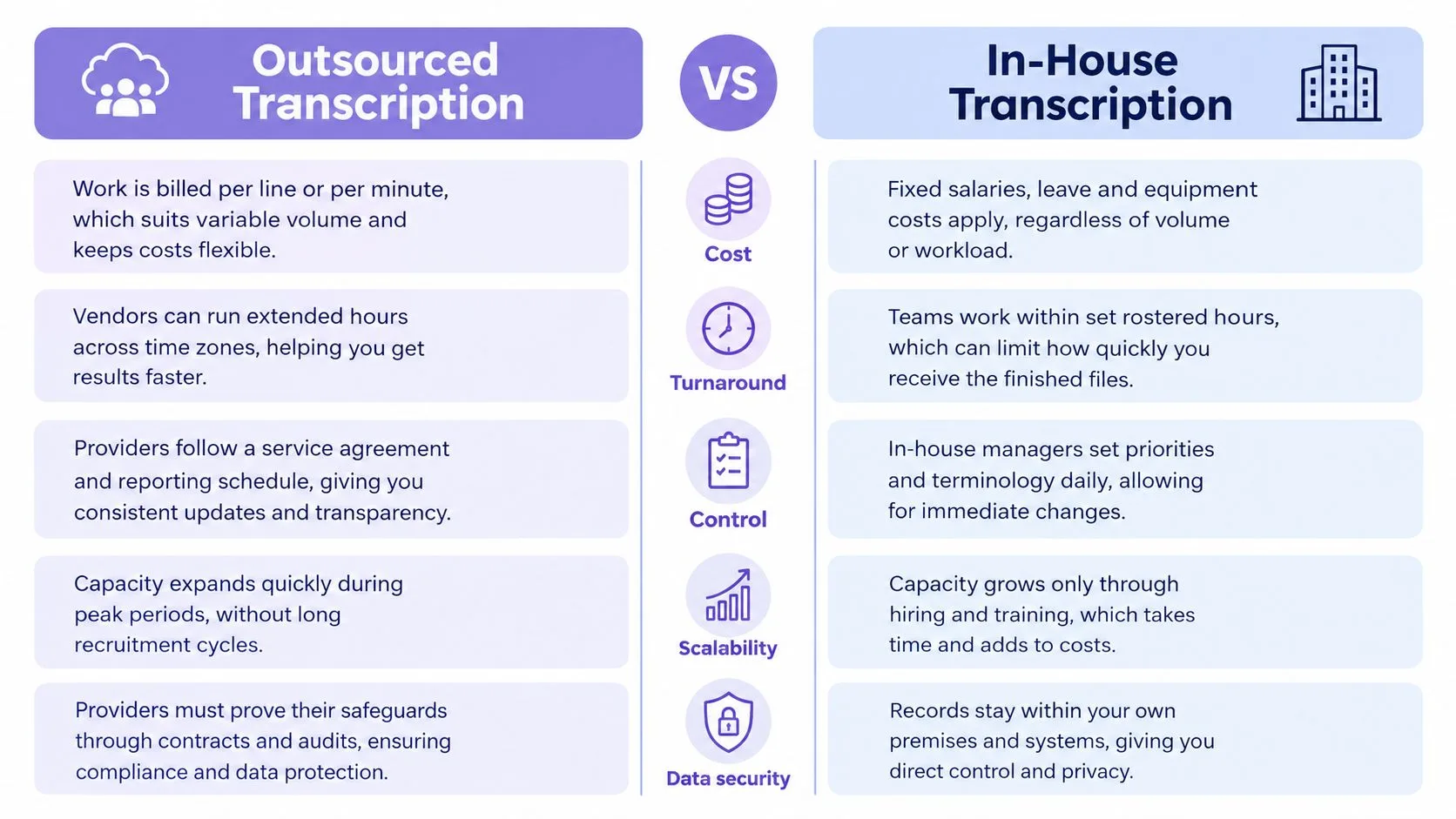
The choice between outsourcing and keeping transcription in-house depends less on which option sounds modern and more on what your practice needs to control. Outsourcing can make capacity easier to adjust when dictation volumes fluctuate. An in-house team can be closer to clinicians and may learn local terminology through day-to-day feedback.
| Criterion | Outsourced service | In-house team |
|---|---|---|
| Control | Work is governed by service terms, agreed priorities and reporting. | Managers can guide daily priorities and terminology more directly. |
| Cost planning | Charges may vary with volume or service model. | Employment and operating costs are less tied to each document. |
| Turnaround | The provider's coverage and workload affect delivery. | The team works within its roster and local capacity. |
| Peak demand | Providers may offer extra capacity, subject to the agreement. | Extra workload can require rescheduling, training or recruitment. |
| Oversight and data handling | The clinic must assess the provider's controls and monitor performance. | Managers oversee staff directly, while still needing sound access and security controls. |
A practice with uneven demand, multiple sites or limited room to recruit may find outsourcing easier to manage. But the contract needs to spell out how urgent work is prioritised, who handles corrections and how patient information is protected. Outsourcing moves some operational work outside the clinic; it doesn't move accountability for selecting and overseeing the arrangement.
An in-house team may suit a clinic where clinicians need frequent informal discussion about specialty terms or document preferences. The trade-off is that staff availability, training and workload stay with the practice. A small team can be closely supervised, but may have less flexibility when dictation piles up.
The video below can help frame the operational comparison. Use it as a prompt for your own requirements, rather than as a substitute for checking each provider's terms.
Outsourced versus in-house transcription at a glance: compare the actual supervision, service coverage, data-handling arrangements and workload in your clinic. Revisit the decision when volumes or sites change, rather than treating today's setup as permanent.
Pricing Models and What Drives Cost
A transcription quote is easier to compare when you know what the provider is charging for. Some services bill by line or page, others by audio minute or document. Subscription and bundled plans usually package a defined service allowance, but clinics should check what happens when use exceeds it.
Think of the options like household bills. A fixed plan makes budgeting more predictable, while pay-as-you-go can be economical when usage is low and less predictable when work spikes. Neither is automatically cheaper. The right comparison is the expected bill for your real mix of documents, including any extra work needed to turn a transcript into a usable clinical record.
Ask what changes the total
Audio quality affects how much correction or clarification a document may need. Specialty vocabulary, unusual terminology and complex formatting can also change the work involved. So can urgent turnaround, fluctuating volume and requests to organise information into structured fields rather than return narrative text.
The quoted rate may not cover every stage. Ask whether the fee includes formatting, revisions, secure delivery, platform access, urgent work and integration support. Confirm how the provider handles unclear audio or incomplete dictation, and whether rework caused by recognition or transcription errors is treated differently from a change requested by the clinic.
Practical rule: Ask for an itemised quote using the document types your clinic actually sends, then check which tasks each charge includes.
For an in-house comparison, don't look only at an employee's salary. Include the cost of supervision, training, leave cover, equipment and the time staff spend handling submissions, chasing incomplete dictation and correcting documents. Those costs may be spread across other duties, but they still affect the clinic's capacity.
A useful comparison worksheet can include:
- Charging basis: Is the rate per line, page, audio minute, document or subscription?
- Included work: Does it cover formatting, review and delivery, or only transcription?
- Variable charges: What adds fees, such as urgency, specialist terminology or after-hours work?
- Overage terms: What happens when the clinic exceeds an allowance?
- Exit and data handling: What happens to stored files and access when the agreement ends?
Keep the assumptions consistent. If one quote includes structured formatting and another covers plain text only, they aren't directly comparable. Ask each provider to price the same representative sample and describe any work that would be billed separately.
Service Level Agreements to Check Before Signing
A service-level agreement should turn general assurances into commitments your practice can monitor. “Fast turnaround” isn't useful if the clinic can't tell when the clock starts, which document types are covered or what happens when a deadline is missed.
Ask for turnaround expectations by document type and urgency. The agreement should also explain platform availability, support response times, escalation routes and how the provider reports problems. If a report is delayed or returned with an error, your team needs to know who owns the correction and how it will be resolved.
Measure accuracy, not just fluency
A transcript can sound polished and still contain a clinically significant error. In an Australian University of Canberra study using simulated nursing handovers, speech-recognition software correctly recognised 5,276 of 7,277 spoken words, approximately 72.5% word-level accuracy, as described in the researchers' clinical speech-recognition benchmark. The study is an indicative technical benchmark based on simulated scenarios, not a guarantee of performance in every clinic or setting.
That distinction matters. A system may produce readable prose while mishandling a medication, a negation or a follow-up instruction. Accuracy needs to be checked against the source, and the review process should make it straightforward to spot and correct questionable wording.
The agreement or trial plan should say how quality is assessed. Consider asking for:
- A defined review process: Can staff compare the draft with the source audio or recording?
- Sampling and error categories: How will the clinic identify omissions, substitutions and clinically serious corrections?
- Correction handling: Who fixes an error, how is it documented and what happens if the same issue recurs?
- A clear draft status: Can unfinished or unchecked content be distinguished from signed notes?
- Service reporting: Will the provider share performance information in a format the practice can review?
Set the expectations before live use, then test them with documents representative of your specialties and accents. A trial should assess more than delivery speed. The clinic should record whether clinicians can verify the output and whether the final note is fit for its intended workflow.
Compliance, Consent and Patient Identity Checks
The Australian Digital Health Agency states that health information receives heightened privacy protection under applicable federal, state and territory legislation. That principle matters whether a clinic uses an outside transcription provider, in-house staff or software that processes speech.
A common misunderstanding is that a tool outside medical-device regulation is therefore outside governance. The distinction is more complicated. The RACGP's guidance on AI scribes in practice explains the difference between tools that transcribe or summarise conversations and tools that add clinical suggestions. A product's regulatory status doesn't remove the clinic's need to consider privacy, consent, cybersecurity and clinician accountability.
Check the destination before sending the record
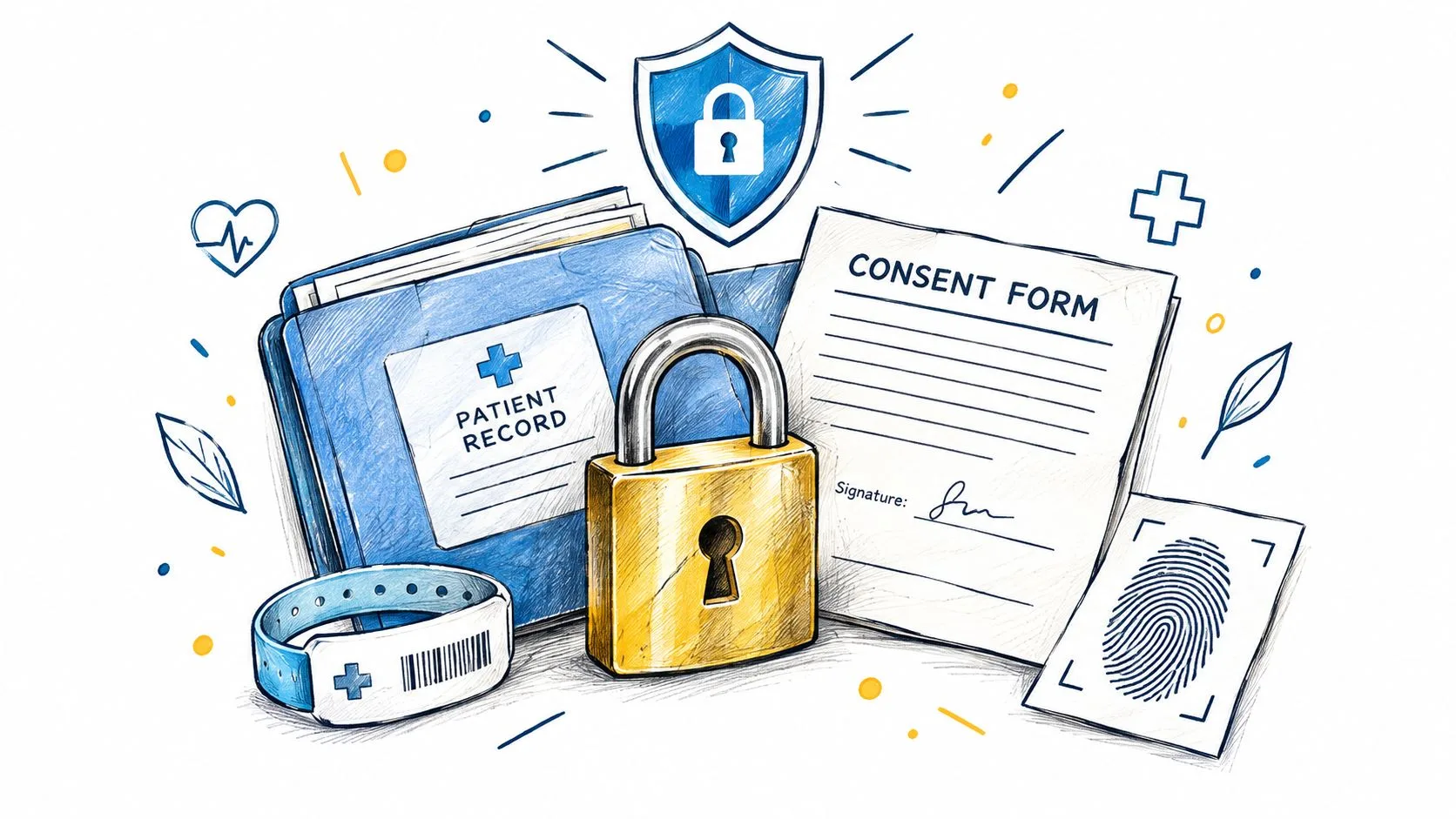
Patient matching is like addressing a sealed envelope. The contents may be correct, but the clinic must verify the address before delivery. Confirm patient identity before attaching a transcript, preserve who authored or reviewed it, and keep draft content distinct from signed clinical material.
Ask how the system handles Healthcare Identifiers, including linking an Individual Healthcare Identifier to the local patient record. For document exchange, the Australian Digital Health Agency's electronic medical record standards guidance recommends FHIR-compliant APIs and describes relevant Australian terminology standards, including SNOMED CT-AU, ICD-10-AM/ACHI/ACS, Australian Medicines Terminology and LOINC.
Standards can reduce the need for bespoke interfaces, but they don't replace local matching rules or review. Clinics still need consent handling, access controls, audit logs and a way for clinicians to verify what will become part of the record.
Before onboarding, establish whether audio is recorded, where it is processed and stored, how long it is retained, whether overseas disclosure occurs, and how patients can decline recording without affecting care. The secure file transfer methods used for clinical documents are one part of the picture; the clinic should also understand vendor access, subprocessors and breach-response arrangements. For a broader security-testing perspective, ThreatExploit AI's overview of how to test HIPAA compliance may help frame questions, but Australian practices should assess their own local obligations rather than assume overseas rules apply.
Choosing a Provider and Your Next Step
A provider comparison should cover the whole workflow, not just the transcript. A low rate won't help if the clinic can't tell where audio is stored, who can access it or how a draft gets matched to the right patient.
Use a practical checklist in provider discussions:
- Scope: Which specialties, dictation formats and report types does the service support?
- Consent and storage: Is audio recorded, where is it processed and stored, how long is it retained, and can patients opt out without affecting care?
- Verification: How does the clinic review transcripts, measure errors and document clinician sign-off?
- Integration: How are patient identity and author attribution checked, and how does the output reach the practice-management system?
- Service and price: What are the turnaround commitments, included tasks, extra charges and escalation arrangements?
- Security: What access controls, audit information, subcontractor disclosures and incident processes can the provider explain?
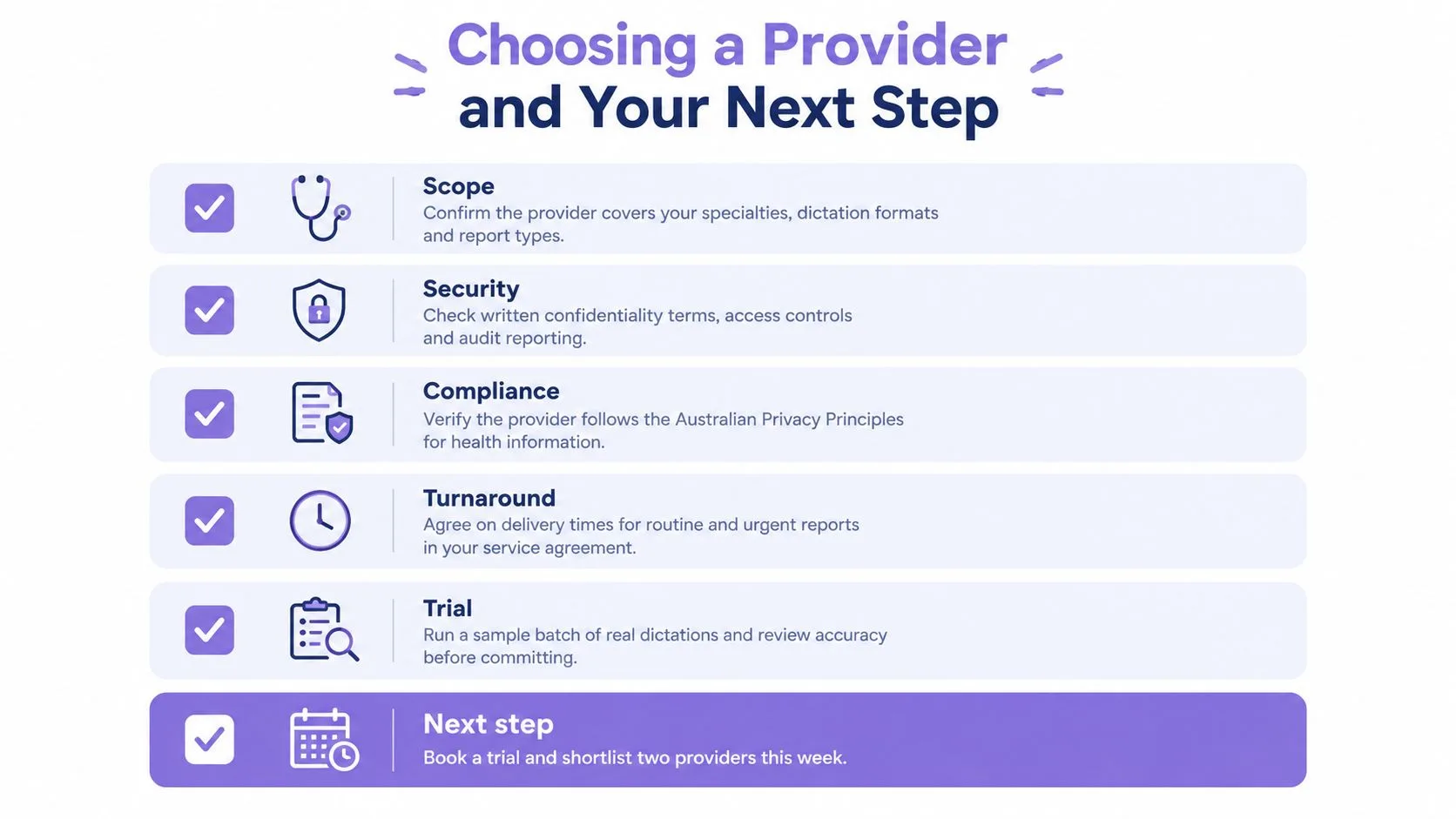
The most useful next step is a time-limited trial using dictations that reflect your clinic's real work. Have the clinicians who sign the notes review the output. Record the time spent editing, the types of corrections needed and whether any errors could affect care. That gives the practice a clearer basis for comparing providers than a demonstration using unfamiliar sample audio.
Also check the route into your existing electronic medical records software. TOOLii's Doctor Consult transcribes consultations and generates structured notes for clinician review, with API connectivity to practice-management systems including Best Practice and Medical Director. As with any option, confirm how its workflow fits your consent, security, identity-checking and verification requirements.
Shortlist two providers, run the same checklist with each and keep a written record of the trial results before you commit. That gives your practice a concrete basis for deciding whether the service is accurate, workable and appropriately governed.
If your practice is assessing consultation transcription, review TOOLii's Doctor Consult alongside your consent, data-handling and clinician-verification requirements. Visit TOOLii to see how its healthcare automation tools fit into practice workflows and connected systems.