
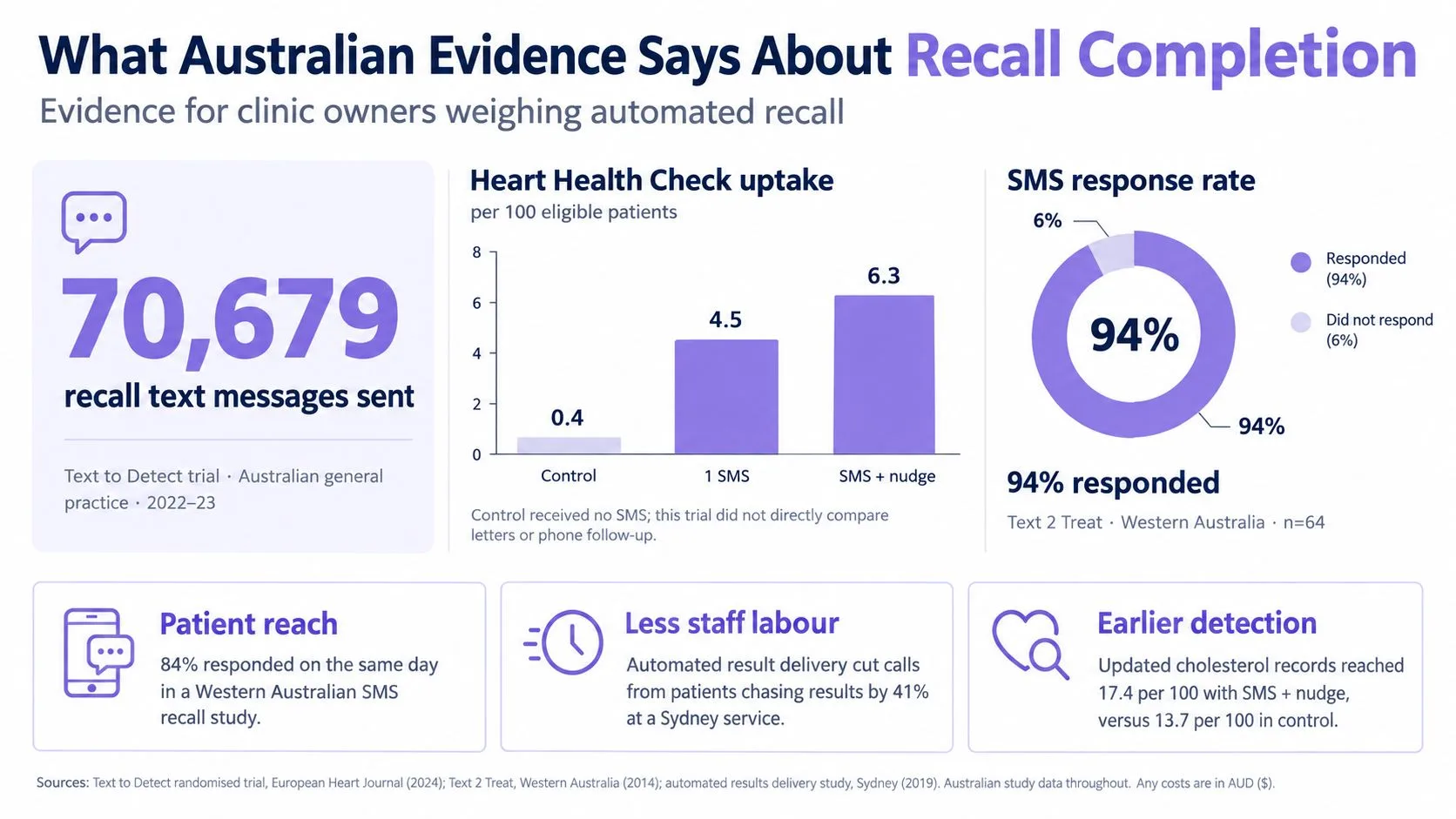
A recall appointment is a clinically directed request for a patient to return within a specified timeframe because a GP has determined follow-up is necessary. In Australian evidence, Heart Health Check uptake rose from 0.4 per 100 eligible patients without a recall to 4.5 per 100 with a standard recall and 6.3 per 100 with a nudge recall in the Text to Detect trial.
The distinction matters on a busy practice day. A patient calls about an overdue blood test, a GP has signed off a result that needs review, and a half-completed note sits in the patient file. Is the receptionist sending a routine reminder, or is the clinic responsible for making sure a clinically important follow-up happens?
That question captures the core recall appointment meaning. A recall is not just another message in the appointment system. It's a documented clinical-care task with an owner, a due date, contact attempts, an outcome and, where necessary, escalation.
Table of Contents
- Why the Recall Appointment Meaning Matters in a Real Clinic
- What a Recall Appointment Really Is and What It Is Not
- The Anatomy of a Safe Recall Workflow
- What Australian Evidence Says About Recall Completion
- How Automated Recall Systems Like iRecall Work in Practice
- Manual Recalls vs Automated Recall Workflows
- Metrics That Prove Your Recall System Is Working
Why the Recall Appointment Meaning Matters in a Real Clinic
At 9.15 am, a patient calls reception after a blood test and says the GP told them to book. The record contains only, “Contact patient.” There is no due date, no indication of whether the GP wants a routine appointment or a prompt review, and no record of previous contact.
The receptionist must now piece together a clinical decision from incomplete information. Was the result significant? Has someone already spoken with the patient? Should reception explain why the appointment is needed? Can the patient safely wait for the next routine opening?
That work depends on understanding the recall appointment meaning. A routine reminder prompts a patient to arrange preventive care, such as immunisation or screening. A recall begins with a clinician's decision that a particular follow-up is required. The message may look similar, but the practice carries a different responsibility.
The missed handover
A GP may create a recall after reviewing an abnormal investigation and ask the patient to return within a defined timeframe. If the task sits in a general inbox, it can disappear when reception becomes busy, a staff member takes leave, or the list is checked irregularly.
The patient may expect the practice to call. The practice may expect the patient to book. Without an assigned owner and a recorded outcome, the follow-up remains open.
Practical rule: If a GP has decided that follow-up is clinically necessary, treat the item as a recall until the record shows that the required action has been completed or safely resolved.
The RACGP guidance on managing patient information for preventive care describes a recall as a proactive request for a patient to return when follow-up is clinically significant. It also recommends documenting and initialling every recall contact attempt in the medical record.
Why the label changes the work
The label determines how the task enters the clinic's workflow. Staff can assign responsibility, record contact attempts, apply the clinical timeframe, and monitor the item until the required care is completed or safely resolved. A booked appointment alone does not prove that follow-up has occurred.
That makes recall appointment meaning a practical operating rule, not a vocabulary exercise. It affects what the receptionist does next, what the GP can audit later, and how the practice responds when a patient does not attend or cannot be reached.
Those four obligations, responsibility, documentation, prioritisation and closure, distinguish a recall from a reminder and are defined precisely in the next section.
What a Recall Appointment Really Is and What It Is Not
A recall appointment is a proactive, clinically directed request for a patient to return within a specified timeframe because a GP has determined that follow-up is necessary. It commonly follows a clinically significant test result, an investigation, a referral, a review of an existing condition or a defined preventive-care need.
A routine reminder has a different starting point. It encourages a patient to consider or complete care, but it isn't necessarily based on a clinician's decision that a particular patient must return for a specific clinical review.
A useful analogy is a delivery. A recall is like a flagged delivery that must reach the intended person and be signed off. The practice needs evidence that the message was sent, the patient responded where possible, and the required follow-up was completed or escalated. A reminder is more like a calendar invitation. It prompts an action, but it doesn't carry the same closed-loop obligation.
Recall vs Reminder at a Glance
| Dimension | Recall Appointment | Routine Reminder |
|---|---|---|
| Reason | A GP has determined that follow-up is clinically necessary | The practice encourages preventive care or a routine action |
| Typical trigger | Significant result, investigation, referral, condition review or defined clinical follow-up | Immunisation, screening or a general preventive-care prompt |
| Timing | Has a clinically meaningful timeframe or urgency | May follow a general schedule |
| Practice responsibility | The practice makes documented contact attempts and monitors the outcome | The practice prompts the patient, with less clinical escalation attached |
| Record | Contact attempts, responses, attendance and resolution should be traceable | The message may be recorded as routine communication |
| Closure | Requires evidence of completed follow-up or documented resolution | Usually closes when the patient responds or the routine action is recorded |
The Royal Australian College of General Practitioners connects recall management with patient safety. Failure to follow up clinically significant results can create professional-liability and safety risks, so a recall can't be treated as promotional messaging or ordinary appointment administration.
For a new receptionist, the safest question is simple: “What clinical decision created this task, and what must be recorded before we can close it?” That question keeps the workflow tied to the patient's care rather than to the act of sending a message.
If your team handles general outbound calls as well, it can be useful to distinguish a clinical recall from a courtesy interaction. The Appel de courtoisie guide offers broader context on courtesy calls, but a medical recall still requires the stricter clinical record and follow-up discipline described by the RACGP.
The Anatomy of a Safe Recall Workflow
A safe recall workflow behaves like a stateful queue, not a single SMS. Each item starts with a clinical decision and moves through identifiable states until the patient attends, the GP documents another resolution, or the practice escalates the outstanding task.
In Best Practice, the exact screens and labels may depend on the practice configuration, but the underlying stages should remain clear.
From clinical decision to assigned task
The GP creates the recall after deciding that follow-up is needed. The record should preserve the initiating event, the required timeframe, the urgency and the type of review. A label or code should separate the recall from routine reminders so staff can filter the right worklist.
The task then needs an owner. That might be a particular team member, a nursing group or a reception queue, but “someone will contact the patient” isn't a reliable assignment.
Contact, response and verification
The assigned staff member contacts the patient through an approved channel and records what happened. A useful entry should show the date, communication method, outcome and any next action. If the patient doesn't answer, the practice should follow its defined contact and escalation policy rather than leaving the task in an ambiguous state.
A booking also needs verification. The system should distinguish between a message sent, an appointment booked, an appointment attended and a follow-up clinically resolved. These are different states, and collapsing them into “done” hides gaps.
A practical recall checklist includes:
- Clinical origin: Identify the GP decision, result, investigation, referral or care activity that created the recall.
- Due date and urgency: Record when follow-up is needed and how it should be prioritised.
- Assigned owner: Give a person or defined team responsibility for contact and monitoring.
- Approved communication: Use the practice's authorised SMS, phone or other communication pathway.
- Audit trail: Record every attempt, patient response and staff action in the health record.
- Attendance status: Confirm whether the appointment occurred, not merely whether it was booked.
- Escalation state: Move overdue or unreachable recalls into the practice's documented escalation process.
- Closure evidence: Close the recall only when the required follow-up or an appropriate clinical resolution is recorded.
Practices should avoid running one list in Best Practice and another disconnected spreadsheet. Fragmented systems make it harder to know which list is current and who owns an overdue item. Guidance on workflow automation best practices is relevant here because reliable automation depends on clear triggers, ownership, status changes and exception handling.
A practice reviewing its recall process can also consider healthcare workflow software that keeps the source record and operational follow-up connected. Automation should preserve the clinical decision, not create a parallel administrative record.
What Australian Evidence Says About Recall Completion
A recall list can look busy while producing little completed care. The Australian evidence points to a different test: whether a clinically eligible patient receives a relevant invitation, can reach the intended service and ultimately completes it.
The Text to Detect randomised trial covered 206 Australian general practices, with a median of 560 eligible patients per practice. Researchers sent 70,679 recall text messages and 34,406 additional nudge reminders. Heart Health Check uptake reached 0.4 per 100 eligible patients in the control group, 4.5 per 100 with standard recall and 6.3 per 100 with the nudge approach, according to the published trial abstract.
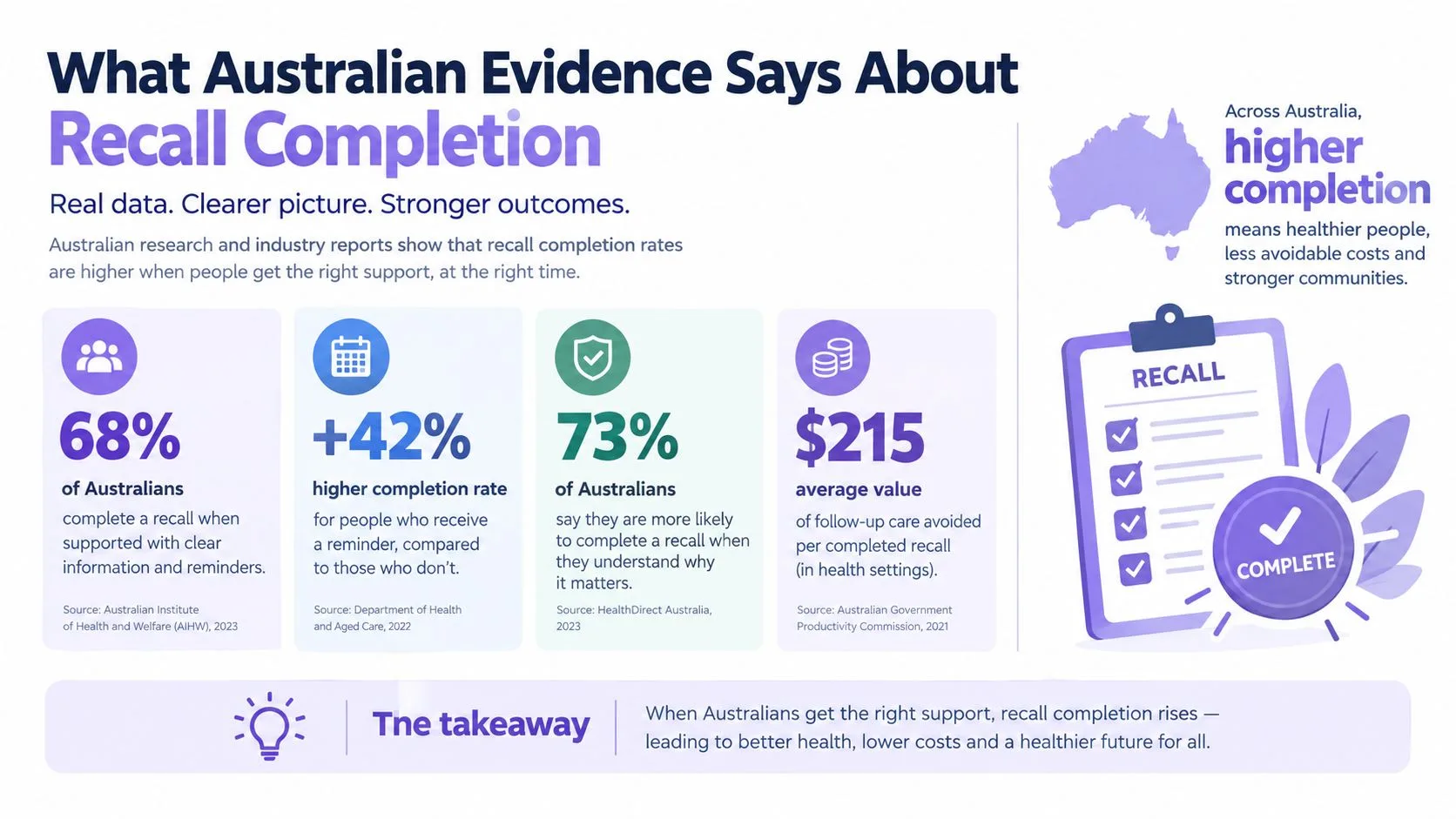
Relative to control, those results represented approximately 11-fold and 16-fold increases. Sending two SMS messages instead of one produced a statistically significant 40% increase in uptake. Updated cholesterol measurements were also 31.6% higher in the standard-recall arm and 60.2% higher in the nudge arm than in control practices, as reported in the trial.
The practical lesson is not to send messages indiscriminately. A recall works more like a labelled clinical pathway than a general announcement. The patient belongs to a defined eligible group, the message identifies a particular service and the practice can connect the contact attempt with the care delivered. That connection makes completion auditable.
What the earlier pilot adds
An earlier Australian pilot sent an SMS recall for cardiovascular-risk assessment to 41,586 eligible patients. 5,486 patients, or 13.2%, clicked the embedded information link. Intervention practices recorded a median of 67.5 Heart Health Checks, compared with 0 in control practices during the study period. After adjustment for practice size, rurality and socioeconomic factors, practices sending recall SMS messages were expected to complete approximately 13.9 times as many Heart Health Checks as comparable practices that did not send recalls, as summarised by RACGP preventive-care guidance.
The pilot also shows why a delivered message or a clicked link is only an intermediate measure. Overall eligible attendance did not differ significantly between intervention and control practices over two months, despite the larger number of recorded Heart Health Checks in intervention practices. A clinic should therefore examine both the pathway stages and the final clinical outcome.
For Australian general practice, the conclusion is clear. Define who is eligible, connect the recall to the intended service, and judge success by completed care rather than message volume alone.
How Automated Recall Systems Like iRecall Work in Practice
Automation starts after the GP's clinical decision. It doesn't decide whether a patient needs follow-up, interpret an abnormal result or replace the clinician's judgement. It organises the operational work that follows, so the recall remains connected to the originating clinical event.
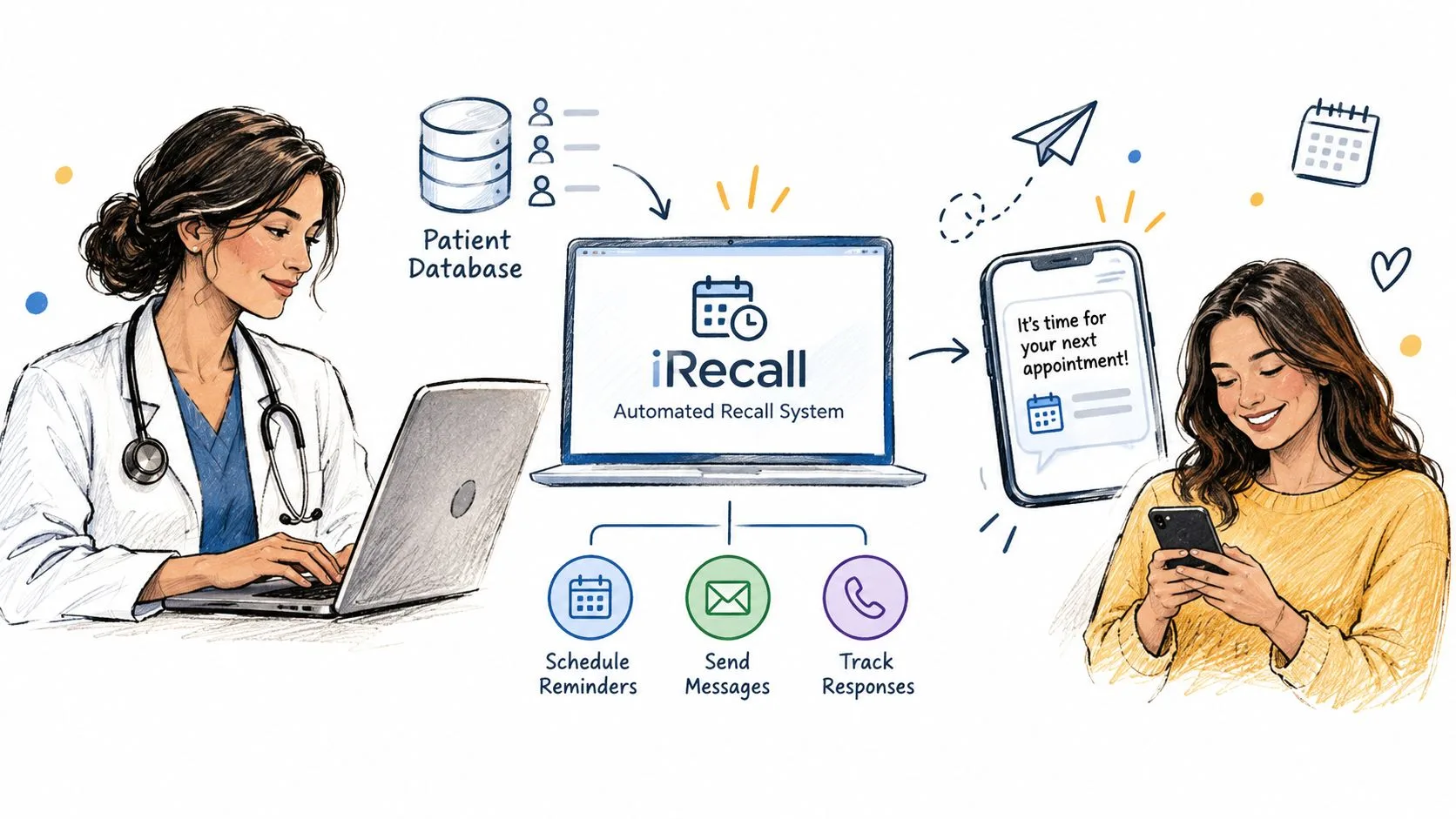
A system such as iRecall can support a defined eligibility list for a clinical activity, prepare outreach through approved communication channels and connect the response with appointment booking. When integrated with Best Practice or another practice-management system, the workflow can retain the patient context rather than forcing staff to copy information into a separate spreadsheet.
The operational sequence
A well-designed automated recall follows the same logic as a manual workflow, but applies it consistently:
- Define eligibility: The practice identifies patients who meet the clinical or preventive-care criteria established by the GP or practice protocol.
- Create the recall: The record contains the reason, due timeframe, urgency and initiating clinical event.
- Start outreach: The system sends an approved SMS or supports another configured contact method.
- Capture response: Replies, failed delivery, booking requests and unreachable patients become visible states rather than informal notes.
- Connect booking: The patient is directed to an appropriate appointment pathway, with the recall reason available to staff.
- Verify completion: Attendance and clinical resolution are recorded against the original recall.
- Escalate exceptions: Overdue, unanswered or clinically urgent items move to a defined staff queue.
This structure changes throughput and traceability, but it doesn't transfer clinical responsibility to software. RACGP expectations for documentation still apply, and the practice remains responsible for deciding what staff may communicate, how contact attempts are recorded and when a GP must review an exception.
The same principle applies when a clinic evaluates building automated voice workflows. Voice can be another communication channel, but it still needs approved messaging, patient identification, an auditable outcome and a clear route back to the clinical workflow.
For practices assessing iRecall, the useful questions are operational rather than promotional:
- Does the system preserve the source record in Best Practice?
- Can staff separate recalls from ordinary reminders?
- Can the team see outstanding items by urgency and status?
- Does it record contact attempts and responses?
- Can staff identify which booked patients attended?
- What happens when a patient doesn't respond or a recall becomes overdue?
Automation is doing its job when it makes those answers easier to retrieve without weakening the GP's control over clinical decisions.
Manual Recalls vs Automated Recall Workflows
Manual recall processes can work in a small, tightly coordinated practice. They become harder to defend as the list grows, clinicians use different habits or several staff members share responsibility.
The common failure isn't usually that no one cares. It's that the task is distributed across a result inbox, a receptionist's note, a phone list and a calendar. A staff member may record the first call but forget the second. An overdue list may be reviewed only during a periodic administrative check. A patient can disappear from view when the person who owns the list is away.
| Dimension | Manual Recall Process | Automated Recall, such as iRecall |
|---|---|---|
| Time from decision to contact | Depends on when staff notice and process the task | Can trigger a defined outreach workflow after the recall is created |
| Contact history | Staff enter attempts individually and may use inconsistent wording | Contact events and responses can be collected in a structured workflow |
| Overdue visibility | Relies on staff checking lists and remembering exceptions | Outstanding states can be surfaced for review and escalation |
| Reception workload | Repetitive identification, messaging and status updates remain manual | Routine outreach and status handling can be system-supported |
| Consistency | Varies between clinicians, shifts and staff availability | Uses agreed rules for eligibility, messaging and follow-up |
| Clinical accountability | Can be obscured by disconnected notes | The clinical decision remains with the GP while operational states stay traceable |
A spreadsheet can hold a list, but it can't by itself prove that the right patient was contacted, that the appointment occurred or that the clinical task was resolved.
The trade-off isn't “human care versus automation”. It's whether the practice wants its existing clinical responsibility supported by a reliable operational queue. Teams considering broader automated appointment reminders should keep recall messages separate from routine appointment prompts so patients and staff understand the difference.
Manual work may still be appropriate for exceptions, sensitive conversations and clinical escalation. Automation is most useful for the repeatable parts: identifying eligible patients, initiating approved outreach, recording responses and keeping unresolved items visible.
Metrics That Prove Your Recall System Is Working
A recall system is working only when the practice can demonstrate more than outbound activity. Track the journey from clinical decision to completed review.
The RACGP clinical information-system guidance supports a single actionable view, prioritisation and an audit log showing what happened, when it happened, the patient's response and whether follow-up was completed.
Useful measures include:
- Contacted within target time: Shows whether staff act within the clinically meaningful timeframe.
- Overdue recalls by urgency: Reveals which unresolved tasks need immediate attention.
- Contact-attempt completion: Confirms that required outreach steps are performed and recorded.
- Booked-to-attended conversion: Separates an appointment arranged from a patient who received the intended follow-up.
- Median time from clinical decision to completed review: Shows the total delay across the workflow.
- Documented closure: Confirms that each recall ended with attendance, clinical resolution or an appropriate escalation record.
These measures turn the recall appointment meaning into a controlled clinical workflow. Without them, a practice may know that messages were sent but not whether patients received care.
TOOLii provides Australian medical practices with automation for recalls, appointments and patient communications, including iRecall workflows that connect follow-up activity with established practice-management systems such as Best Practice. Visit TOOLii to assess how a closed-loop recall process could fit your clinic's current workflow.