
Most advice about a referral letter sample starts with wording. That's the wrong starting point for an Australian clinic. A referral isn't just a courteous note between doctors. It's a clinical handover, a Medicare-related document and a patient-record event that must be complete, traceable and routed to the right provider.
A well-written letter can still fail operationally if the patient identifiers are incomplete, the clinical question is vague, the practitioner hasn't signed it, or the final copy isn't retained in the health record. The practical answer is to design the referral as a structured data object first, then render it as a letter that a specialist can read quickly.
Table of Contents
- Why Your Referral Letter Sample is a Compliance Document
- Mandatory Clinical and Administrative Fields
- Navigating Medicare Validity and Expiry Rules
- Comprehensive GP to Specialist Template
- Specialist and Allied Health Variations
- Digitising Templates for Practice Management Systems
- Automating the Referral Workflow with TOOLii
- The Scale and Impact of Referral Automation
- Quick Reference Checklist and Cross References
Why Your Referral Letter Sample is a Compliance Document
A referral has two jobs that are often confused. It must give the receiving practitioner enough relevant information to assess and treat the patient, while also meeting the administrative conditions attached to specialist care and Medicare billing. Treating it as a polite introduction encourages attractive prose but leaves dangerous gaps.
RACGP guidance describes a referral as a signed and dated letter or note that identifies the referrer, patient and receiving healthcare setting, and explains the purpose of referral. It should include relevant history, examination findings, current management, medicines, allergies and adverse drug reactions. The document should also exclude unrelated sensitive information, because a complete referral isn't the same as a complete export of the patient record. The RACGP guidance on referring to other medical specialists provides the clinical and administrative baseline.
What goes wrong with a generic sample
A template that contains only “Dear Specialist, please assess this patient” creates work for the recipient and risk for the practice. Missing identifiers can make matching unsafe. Missing dates or signatures can undermine the document's validity. A vague reason for referral can delay triage because the specialist cannot tell whether the request concerns diagnosis, treatment, procedural opinion, ongoing management or a second opinion.
The same problem appears after transmission. If staff save the outgoing letter to a shared folder but not the patient's source record, the practice loses a reliable history of what was sent. A practical medical document management workflow should preserve the final referral, attachments, destination and delivery status together.
Practical rule: If a field affects patient identification, clinical decision-making, Medicare administration or later auditing, it belongs in the structured referral workflow.
Privacy controls matter just as much as completeness. A referral should contain information needed by the receiving practitioner to diagnose and treat, not every diagnosis or historic note available in the PMS. Practices designing controls can use resources covering healthcare compliance statistics and controls to think beyond the letter itself, including access, auditability and information governance.
Mandatory Clinical and Administrative Fields
A reliable referral letter sample should work as a field specification, not just a page of suggested sentences. Each field needs a reason for being present and a validation rule that tells staff or software when the document isn't ready.
Identity and destination
Start with the patient's full name, date of birth and at least one additional identifier. Use the identifier already accepted by the practice's clinical system, and verify it against the patient record before generating the document. The referrer's name, practice details, provider information, contact details, date and signature should be equally clear.
The destination needs more than a specialist's name. Capture the receiving doctor or service, practice or hospital location, and the intended care setting. A referral addressed to the wrong clinic can be clinically sound and still fail at the point of delivery.
Clinical content
The reason for referral should answer a specialist's first practical questions: what problem needs attention, how urgent is it, and what action is requested? Add the relevant history, examination findings, working diagnosis or clinical question, current management, medicines, allergies, adverse drug reactions and relevant investigations or attachments.
The clinical payload should be selective. Unrelated sensitive history can distract the recipient and breach the principle of minimum necessary disclosure. If the patient needs an interpreter, prefers a particular language or requires communication accommodations, record that information where it supports culturally safe care.
For teams focused on managing referrals accurately, the most useful distinction is between “all available information” and “relevant information”. A structured template makes that distinction visible before the doctor signs.
A practical field order
Use a consistent sequence so doctors, admin staff and receiving services can find information quickly:
- Referral context: Date, referral type, urgency and validity setting.
- Patient details: Full name, date of birth and additional identifier.
- Recipient: Specialist, service, location and preferred transmission method.
- Clinical question: Presenting problem, reason for referral and requested action.
- Clinical summary: Relevant history, examination and working diagnosis.
- Treatment information: Current medicines, allergies, adverse reactions and management already provided.
- Supporting material: Investigation results, reports and attachments.
- Referrer confirmation: Name, provider details, contact information, signature and date.
- Communication needs: Interpreter, language or other accommodations.
Navigating Medicare Validity and Expiry Rules
Referral validity is often configured incorrectly because staff count from the wrong date. Services Australia states that a GP referral to a specialist generally lasts 12 months from the specialist's first consultation, not from the day the GP writes the letter. The same guidance states that specialist-to-specialist referrals generally last 3 months, with different arrangements possible where an indefinite referral is clinically appropriate. See the Services Australia referral rules for the applicable conditions.
That distinction changes how a PMS should calculate reminders. The creation date is useful for audit history, but it shouldn't automatically become the expiry date. The system should capture the first specialist consultation when it becomes known, then calculate the relevant validity context from that event.
Validity is not the same as clinical sufficiency
A referral covers a single course of treatment. A replacement is required after a referral has been lost, stolen or destroyed if further services are to be billed. A new or unrelated condition may require a new referral, even where an earlier referral remains within its validity period.
An indefinite referral can reduce repeated administration for an ongoing condition, but it isn't a licence to stop updating the specialist. The receiving practitioner still needs clinically relevant information, and the referral may not cover an unrelated problem. Configure the template with an explicit validity selector rather than hiding the choice in free text.
What staff should record
At minimum, retain the referral date, the validity type, the specialist's first consultation date when available, the destination and the final signed document. A reminder should prompt staff to confirm the referral status before a future appointment, not just issue a new letter automatically. That approach reduces avoidable patient billing problems without encouraging unnecessary replacement referrals.
Comprehensive GP to Specialist Template
The following referral letter sample is designed as a structured form. It can be rendered into a letter, PDF or interoperable clinical document, but the underlying fields should remain discrete in the practice system.
Referral details
Referral date: [DD/MM/YYYY]
Referral type: [Initial referral / ongoing referral / replacement referral / other]
Validity setting: [Standard period / shorter period / longer period / indefinite where clinically appropriate]
Relevant expiry context: [Record the specialist's first consultation date when known]
Urgency: [Routine / urgent / immediate clinical escalation required]
Requested service: [Consultation / diagnosis / treatment advice / procedure / ongoing co-management / second opinion]
Recipient and patient
To: [Specialist or service name]
Practice or hospital: [Name and location]
Patient: [Full legal name]
Date of birth: [DD/MM/YYYY]
Additional identifier: [Identifier used by the practice]
Preferred language: [Language]
Interpreter required: [Yes / No]
Communication accommodations: [Details, if relevant]
Clinical referral
Dear [Specialist or service name],
I'm referring [patient name] for assessment of [specific problem or clinical question]. The requested action is [clearly state what the specialist is being asked to assess, advise on or provide]. The urgency is [urgency], because [brief clinical reason].
Relevant history:
[Include history directly relevant to the presenting problem.]
Examination findings:
[Record relevant positive and negative findings.]
Working diagnosis or clinical question:
[State the current working diagnosis, differential question or reason diagnosis remains uncertain.]
Current management:
[Summarise treatment already provided, response, planned monitoring and relevant precautions.]
Current medicines:
[List medicine names, directions and clinically relevant changes.]
Allergies and adverse drug reactions:
[Record the substance and reaction, or state that none are known according to the current record.]
Investigations and attachments:
[List relevant tests, reports, images or other documents attached. Do not include unrelated results.]
Requested response and referrer details
Please assess [specific request] and provide advice regarding [management question, treatment recommendation, investigation or follow-up]. Please contact the practice if additional information is required.
Referring practitioner: [Name]
Provider details: [Provider information]
Practice: [Practice name, address and contact details]
Secure communication details: [Approved contact method]
Signature: [Handwritten or acceptable digital signature]
Signed date: [DD/MM/YYYY]
This format separates administrative identity from clinical reasoning. It also gives software a clear place to apply checks before the practitioner signs, while preserving a readable final document for the recipient.
Specialist and Allied Health Variations
The GP-to-specialist format is a useful base, but it shouldn't become a universal form with irrelevant fields. The receiving service, clinical question and funding pathway determine how much information belongs in the document.
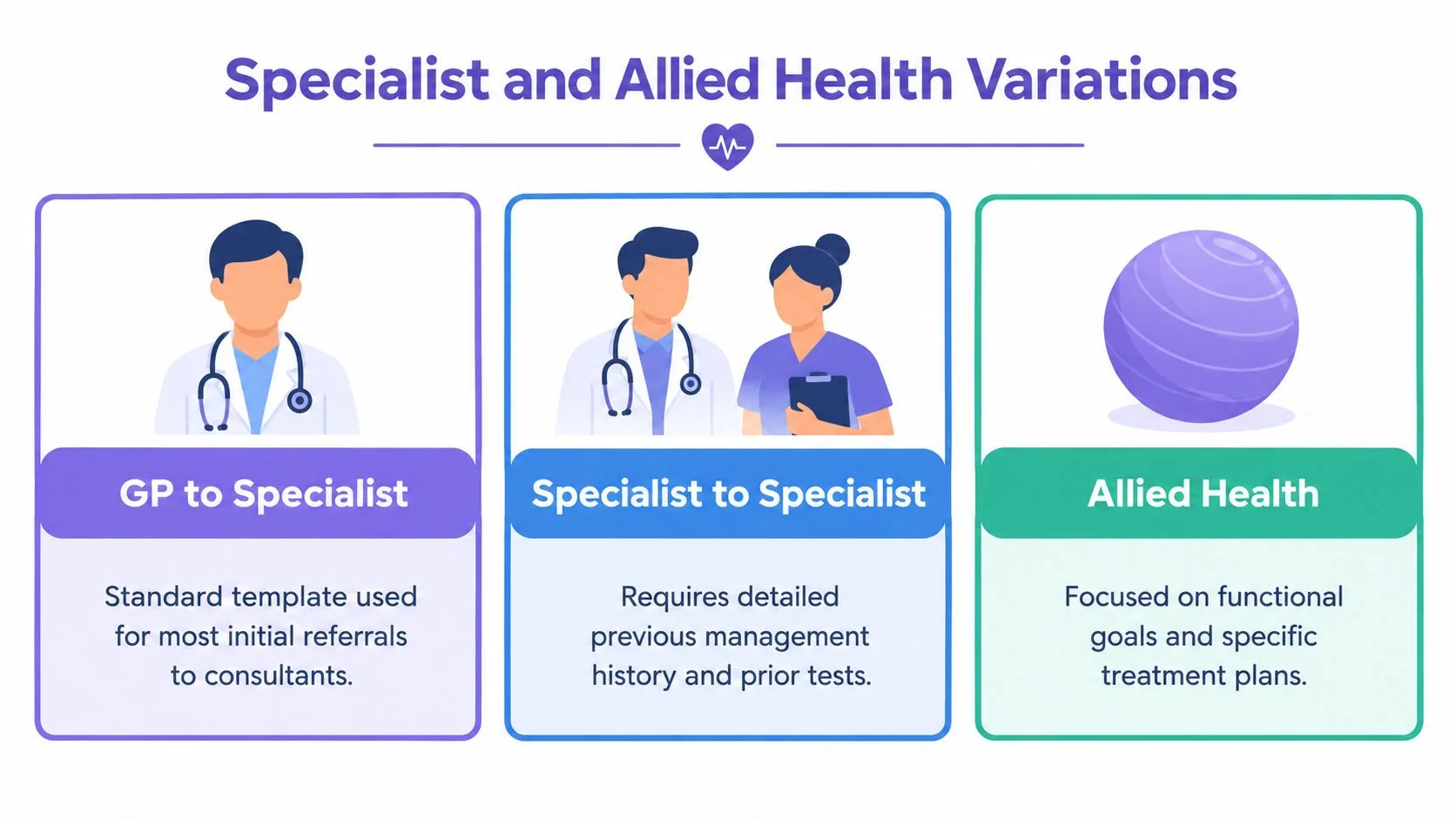
| Referral pathway | Emphasis | Useful adaptation |
|---|---|---|
| GP to specialist | Reason for referral, relevant history, examination, medicines, allergies and requested action | Keep the full clinical handover structure |
| Specialist to specialist | Previous specialist assessment, investigations, treatment response and the new clinical question | Carry forward only relevant prior management |
| Allied health | Functional problem, goals, restrictions, diagnosis and requested intervention | Focus the letter on treatment objectives and practical outcomes |
| Hospital outpatient service | Clinical urgency, triage information, attachments and contact details | Match the receiving service's submission requirements |
A specialist-to-specialist referral may need more detail about previous management because the new recipient is taking over or extending an existing pathway. Its Medicare validity context is also different from a GP referral, so the originating practitioner shouldn't reuse the GP setting.
Allied health referrals require a different centre of gravity. A physiotherapy referral may need functional limitations, precautions and treatment goals. A psychology referral may need the clinical question, relevant history, risk information and communication needs. The letter should remain clinically sufficient without exporting unrelated diagnoses.
Hospital outpatient referrals often depend on triage. Put the urgency, key findings, relevant investigation results and requested service where the receiving team can find them immediately. A beautifully written narrative that buries the triage information isn't an improvement.
The right template is the smallest complete document for that care pathway, not the longest one available.
Digitising Templates for Practice Management Systems
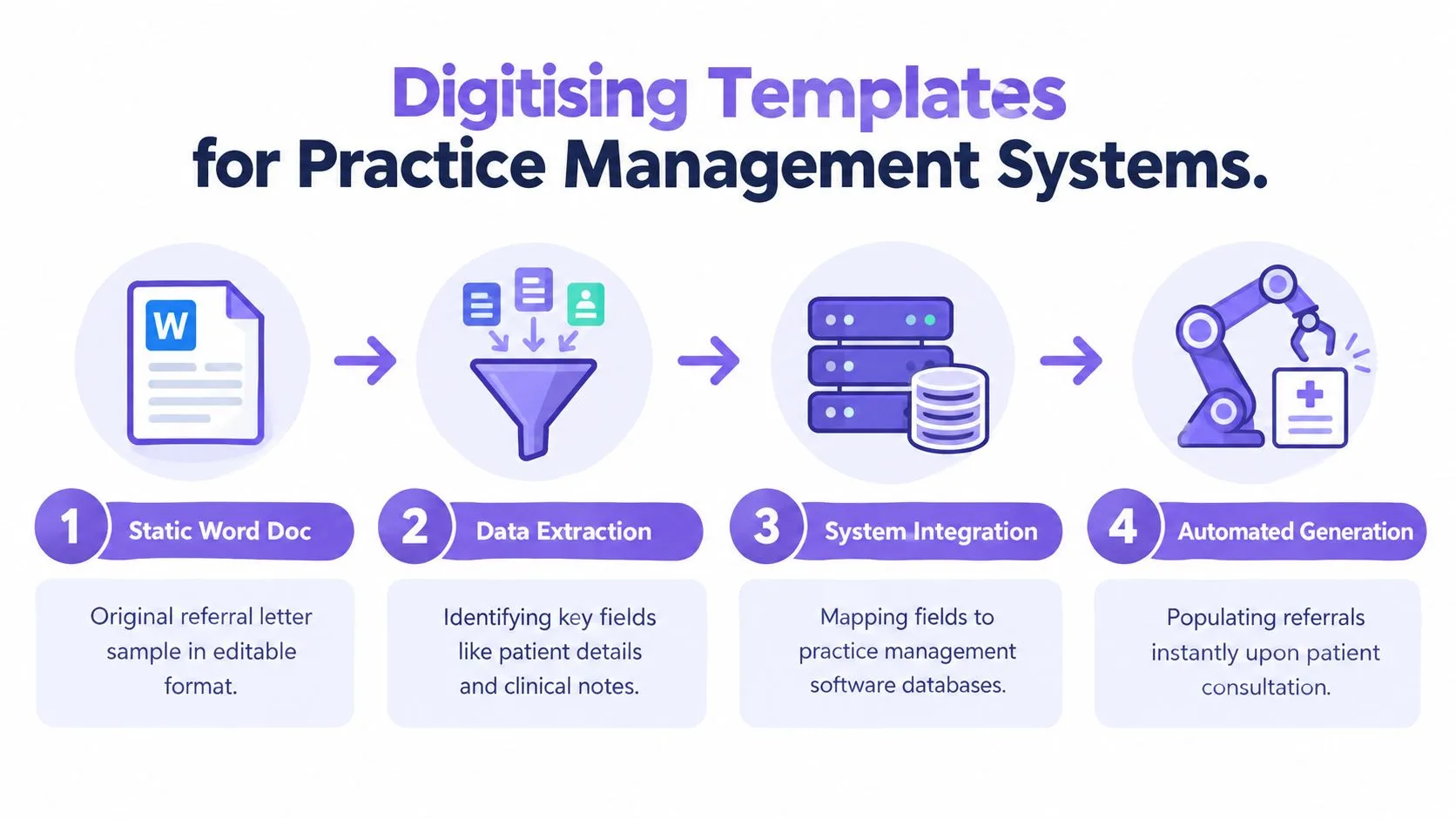
A Word document is a useful starting point, but it's a poor source of truth. Staff can overwrite fields, copy old details into a new referral and save the final version somewhere the clinical record can't find it. Digitisation works when the template becomes a controlled set of fields connected to the patient, practitioner and destination records.
Build the data model before the layout
Map patient identifiers, referral reason, urgency, history, examination, medicines, allergies, investigations, attachments, requested service, author, signature, destination and communication needs as discrete fields. Keep free text for clinical reasoning, but don't use it for values the system must validate or route.
The Australian Digital Health Implementer Hub identifies eReferral as a clinical-document type for transmitting significant patient information between treating providers, alongside specialist-letter documents used in responses. Its clinical-document guidance supports discrete handling of identifiers, clinical reason and attachments. The Australian clinical-document implementation resources are a useful reference for teams working on interoperability.
Apply controls at the right point
A referral generator should block finalisation when essential information is absent. The checks should cover:
- Patient matching: Confirm the selected patient and required identifiers.
- Clinical purpose: Require a reason, urgency and requested action.
- Authorisation: Require the referring practitioner and signature.
- Attachment integrity: Show which investigations are attached and which are intentionally absent.
- Destination: Confirm the receiving service and approved transmission route.
- Audit history: Preserve creation, signing and transmission timestamps.
- Record retention: Save the rendered letter and delivery status to the source record.
The final document should be immutable after signing, or any later amendment should create a new version with its own author and timestamp. That gives the practice a reliable answer when someone asks what was sent, to whom and when.
A team comparing options for document automation software should test the complete workflow, not just the letter editor. The important question is whether the output remains connected to Best Practice, MedicalDirector or another PMS throughout creation, transmission, response and filing.
Automating the Referral Workflow with TOOLii
Automation should remove repetition without taking clinical judgement away from the practitioner. A sound workflow begins with the consultation record, uses structured fields to prepare the draft, presents the clinical content for review, and only then sends and files the signed document.
A typical practice workflow looks like this:
- Identify the patient and destination. The staff member or doctor selects the correct patient record and receiving service from controlled fields.
- Prepare the clinical payload. Relevant history, examination findings, medicines, allergies, investigations and requested action are assembled without copying unrelated information.
- Review and sign. The practitioner checks the clinical question, urgency, attachments and communication needs, then applies the required signature.
- Transmit securely. The final document goes through the approved channel, with the destination and delivery event recorded.
- File both sides. The outgoing referral and later specialist response are linked to the patient record, so the care pathway remains visible.
The same principle applies to incoming documents. Optical character recognition can extract identifying information from a specialist reply, while routing rules can allocate it to the correct patient file. Staff still need exception handling for ambiguous matches and clinical review, but they don't need to retype every field or search manually through an inbox.
Clinical automation also needs transparency. A generated summary can suggest relevant information from recent care plans, but the practitioner must decide what belongs in the referral. The safest design shows the source material, highlights inserted content and records who approved the final version.
Teams assessing automation can also examine Passflow's open-source approach as an example of why inspectable workflows and clear control boundaries matter. In a practice, the same principle means documenting how data moves from consultation to letter, transmission and record retention.
For clinics evaluating healthcare workflow software, the useful test is operational: can the system reduce duplicate entry while preserving the clinician's review, the patient context and an auditable final record?
The Scale and Impact of Referral Automation
Referral work is a core primary-care operation, not an occasional request. Australian general-practice data recorded 13 referrals for every 100 patient encounters in 2009–10, equivalent to 9 referrals for every 100 problems managed. Specialists received 64% of referrals, allied-health professionals received 29%, and hospitals or emergency departments received less than 5%, according to the Australian Institute of Health and Welfare general-practice activity summary.
The same source indicates that, for an average 100 encounters, GPs recorded approximately 8 specialist referrals and 4 allied-health referrals. That distribution matters because a practice isn't managing one standard destination. It's coordinating different recipients, transmission channels, attachment expectations and follow-up tasks.
The downstream pathway is extensive. In 2022–23, Australia recorded 34.5 million Medicare-subsidised referred medical-specialist attendances, involving 8.6 million patients, or 33% of the population, as reported by AIHW data on referred medical-specialist attendances. Each referral event carries administrative work before and after the consultation.
Automation has a practical business case even without assuming a dramatic performance claim. When staff repeatedly search for patient files, re-enter identifiers, attach documents, chase delivery and file specialist replies, small points of friction occupy a high-volume workflow. Structured templates and controlled routing let practice managers improve consistency while giving clinicians a clearer final review.
Quick Reference Checklist and Cross References
Use this checklist before a referral leaves the practice. It's short enough for a procedure manual, but specific enough to support a genuine audit.
- Patient identity: Confirm the name, date of birth and additional identifier against the selected record.
- Recipient: Verify the specialist or service, location and approved transmission route.
- Clinical purpose: State the problem, clinical question, requested action and urgency.
- Relevant evidence: Include the history, examination, working diagnosis, medicines, allergies and relevant investigations.
- Privacy review: Remove unrelated diagnoses and sensitive history that the recipient doesn't need.
- Communication needs: Record interpreter requirements, preferred language or other accommodations where relevant.
- Validity context: Select the appropriate referral setting and record the specialist's first consultation date when known.
- Authorisation: Check the referrer's details, signature and date.
- Attachments: Confirm every listed attachment is present, readable and associated with the correct patient.
- Record retention: Save the final rendered letter, destination and delivery status in the source record.
The referral shouldn't sit alone. Link it to the later specialist letter, investigation reports, treatment plans and relevant chronic-care documentation. A reply that isn't filed against the original request breaks the chain of reasoning, while a referral that includes no follow-up expectation leaves staff unsure whether the episode is complete.
Practice managers should review the template whenever the PMS, transmission method or receiving service changes. Ask whether each field is still necessary, whether missing information is blocked before signing, and whether an authorised user can retrieve the final document without searching outside the clinical record.
TOOLii helps Australian practices digitise medical documents, automate routing and connect referral-related workflows with established systems such as Best Practice and MedicalDirector. Visit TOOLii to see how structured document automation can support cleaner referral creation, secure filing and more consistent clinical administration.